















It’s one of the most powerful exercises you can add to your routine–and if you aren’t already doing them, then you should be. From building explosive power, strengthening your entire posterior chain, and boosting cardio capacity, this exercise delivers maximal results in minimal time.
But here’s the catch: So many people get them wrong, turning this smooth, hip-driven movement into a less effective swinging motion with a danger of lower back pain.
That’s why we’re here: To guide you through exactly how to master the kettlebell swing, whether you’ve never picked up a kettlebell before or you’re looking to refine and master your technique.
From proper kettlebell swing technique, form tips, variations, and of course, making you aware of all the unmissable benefits along the way–this is the only guide you need to master one of the best functional exercises in the book.
From flexible shorts to supportive sports bras, moisture-wicking t-shirts, and, of course, an oversized t-shirt to throw over the top: Shop the latest functional fitness outfits that will have you looking hot while staying cool.
What Are Kettlebell Swings?
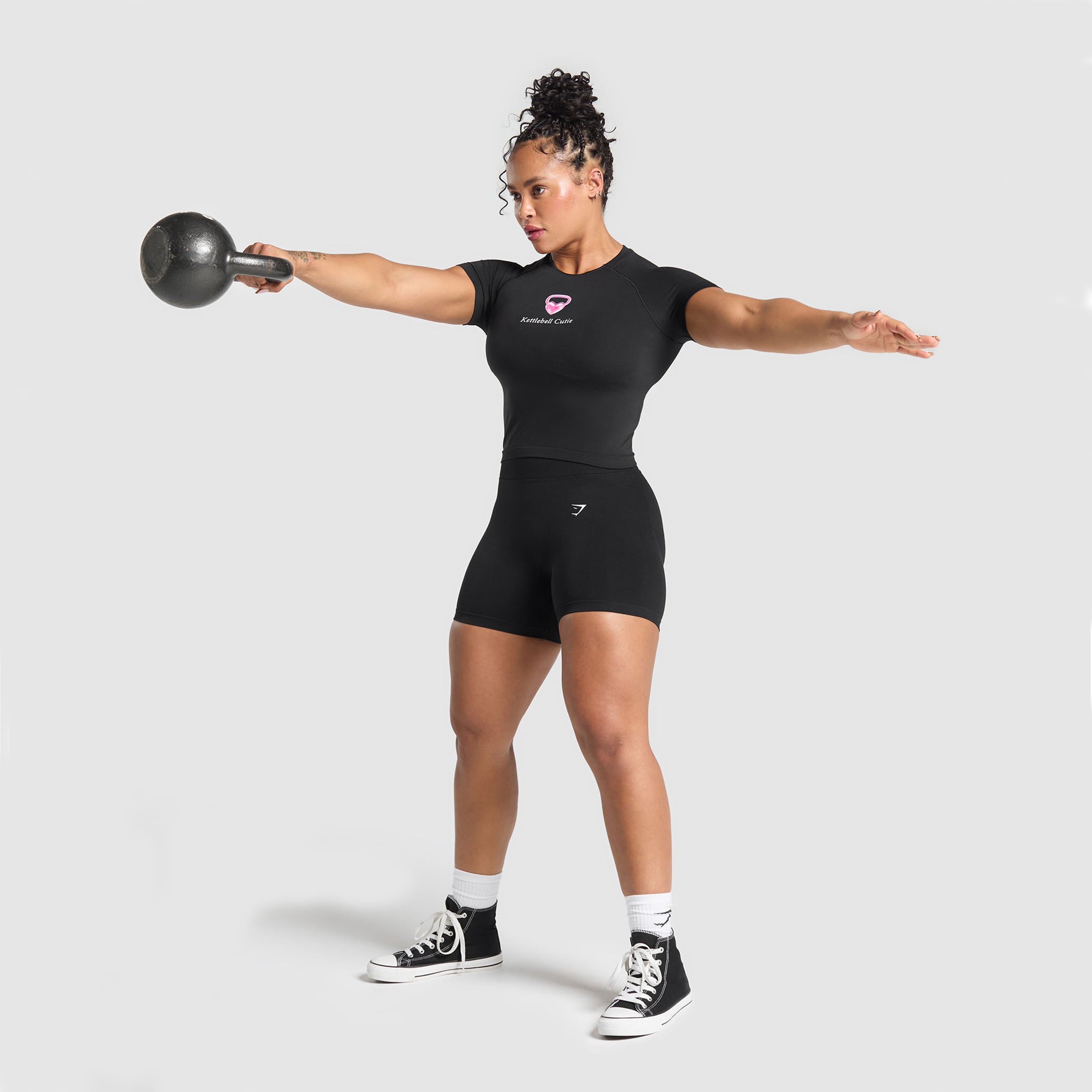
Kettlebell swings are a functional, full-body exercise, performed by swinging a kettlebell from between the knees, up to eye level (or higher) using a hip hinge movement. They are mainly a posterior chain exercise (firing up the glutes and hamstrings), but also work the core, and use upper body muscles to stabilize the body and assist the movement [1].
Kettlebell swings are commonplace in functional fitness classes and sit well within a circuit, HIIT workout, or even as part of a strength superset to build explosive power, hip strength, and cardiovascular fitness.
How To Do Kettlebell Swings
The main style of kettlebell swings is the Russian swing, which ends at shoulder height. This type of swing is considered safer than American swings (that take the kettlebell overhead), which place greater demands on the arms and shoulders, potentially increasing injury risk [2]. With that in mind, it is always best to master the Russian swing before learning the American variation, to become confident with the movement and minimise injury risk before moving onto the more advanced overhead variation.
Always start with the kettlebell on the floor in front of you (never in your hands!). Set up with feet shoulder-width apart, toes pointing forward, with the kettlebell roughly two foot lengths in front of you on the floor.
Hinge at the hips, pushing your butt back, reaching down to grab the kettlebell handle with both hands. Make sure your back is flat and your core is tight.
Tilt the kettlebell back towards you, then, aggressively hike the kettlebell back between your legs toward your butt. Swing it back between them by hinging at your hips with a slight bend in the knees.
Begin the swing by explosively thrusting your hips forward, squeezing your glutes to help you do so, and straightening your legs. Swing the kettlebell up to your eye-line, keeping your elbows close to your sides with a slight bend in your arms.
Let the kettlebell fall naturally, guiding it back between your legs while hinging again.
Repeat the motion smoothly for your desired reps before returning the kettlebell to the floor.
Kettlebell Swing Form Tips
Make sure you are hinging at the hips, rather than squatting. At the start of the movement, you should push your hips back, tilting your pelvis, so there is a slight bend in your knees (similar to an RDL or good morning). Imagine you are pushing a door closed behind you with your butt, rather than bending your knees into a squat. Then, as you swing the kettlebell up, extend your legs, straightening them and squeezing your glutes. (FYI: Don’t wear anything restrictive for these! Split seam shorts are ideal as they allow freedom of movement, while seamless shorts help you glide through every swing.)
Don’t lift with your arms–instead, use power and momentum from your hips to drive the kettlebell up. Most of the work should come from your glutes and hamstrings, not your upper body.
Keep your elbows pinned to your sides, rather than letting your arms fully extend in front of you. This will help you use your hips to drive the kettlebell up and, ultimately, make your swing more powerful.
What Muscles Do Kettlebell Swings Work?
Kettlebell swings are a compound exercise, primarily working the posterior chain muscles of the lower body and the core [1]. These muscles are:
The Glutes: These are the main drivers of the swing, and they should be on fire when performing your kettlebell swings! 🔥
The Hamstrings: As you hinge your hips back, you’ll feel a big stretch in your hammies (which shows you are doing the movement correctly!). The hamstrings also play a key role in hip extension.
The Core: Bracing your core is essential for protecting your lower back during kettlebell swings. A good tip for bracing correctly is to engage your core like you are about to be punched in the stomach!
Kettlebell swings will also engage muscles of the upper body to assist with guiding the bell, stabilizing the body, and supporting the movement, but these are not the target muscles of the movement! These secondary muscles include:
The Lats: Engage to help control the swing path and keep the bell close.
The Shoulders: Stabilize and help guide the bell during the arc.
The Lower Back: Stabilizes the spine and contributes to the hinge movement.
The Quads: Play a supporting role in the hinge and standing phase
The Forearms and Fingers: Help you grip the kettlebell
What Are The Benefits Of Kettlebell Swings?
A Convenient and Accessible Exercise: Requiring only a single piece of equipment, kettlebell swings provide a full-body, high-intensity workout that can be done in a short amount of time. As a low-impact exercise, kettlebell swings are more accessible for those who struggle with high-impact activities such as jumping or running.
Cardiovascular and Metabolic Benefits: Kettlebell swings are commonplace in functional fitness workouts, and they get pretty demanding when the reps get high! By increasing heart rate and oxygen consumption, kettlebell swings effectively increase aerobic capacity [3].
Improvements to Strength and Power: Kettlebell swings increase strength and power, particularly in the lower body. After 6 weeks of kettlebell training, a 9.8% increase in half squat 1RM and a 19.8% increase in vertical jump height were found [4].
Enhanced Core Stability and Postural Coordination: Kettlebell swings use a unique movement pattern called a ‘posterior shear,’ in which one vertebra slides backward (posteriorly) relative to the vertebra below it. This movement pattern makes kettlebell swings effective at restoring and enhancing back health and function and may reduce the risk of injury in activities requiring quick adjustments [1,5].
Kettlebell Swing Variations
American Kettlebell Swings
A variation of the traditional (Russian) kettlebell swings, American kettlebell swings move the kettlebell all the way overhead instead of stopping at shoulder height.
They focus on a greater range of motion, with a 22% longer cycle duration compared to Russian swings, which could make them more suited to building aerobic capacity and endurance [2]. American swings engage the upper body (particularly the shoulders) more than traditional kettlebell swings, making them best suited to well-trained individuals with adequate mobility and technique and less so for those with limited shoulder mobility.
How To Do American Kettlebell Swings:
Set up just how you would for a traditional kettlebell swing, with feet shoulder-width apart and the kettlebell on the ground slightly in front of you.
Hinge at the hips, pushing your butt back to create a slight bent in the knees. Reach forward to grip the kettlebell with both hands, keeping your back flat and core braced.
Hike the kettlebell back between your legs, loading your glutes and hamstrings.
Explosively drive through your hips to swing the kettlebell upward. Swing the kettlebell all the way overhead, so that your biceps are beside your ears and the bottom of the kettlebell faces the ceiling. Lock out your arms and push your head through at the top of the rep.
Let the kettlebell come down in a natural arc, swinging it back between your legs before beginning another rep.
Tip: Start with a lighter weight for this exercise until you’re comfortable with the full overhead motion. Just like the traditional kettle bell swing, the movement should be driven by the hips (not using the arms to move the weight up), so focus on a powerful hip extension and squeezing your glutes. At the top, keep your core engaged, ribs down, and don’t lean back.
Single Arm Kettlebell Swing
Traditional kettlebell swings can also be performed using just one hand. Like the traditional kettlebell swing, this variation is still driven by the hips but will challenge shoulder control, core stability, and grip strength to a greater degree.
How To Do Single Arm Kettlebell Swings:
Set up the same as you would for a traditional kettlebell swing, with feet shoulder-width apart and the kettlebell between your feet.
Hinge at the hips and grab the kettlebell with one hand, keeping your back flat.
Hike the kettlebell back between your legs, just like the two-handed swing.
Explosively drive through your hips to swing the kettlebell to shoulder height. Keep your free arm extended or out to the side to help with balance.
Control the kettlebell's descent, guiding it back through your legs for the next rep.
You can either switch arms after a set number of reps or alternate hands each swing, which is a slightly more advanced variation.
Tip: The key to single-arm kettlebell swings is to keep your shoulders square and avoid twisting! Focusing on engaging your core throughout will help you resist rotation.
Double Kettlebell Swing
This advanced version of a kettlebell swing requires two kettlebells to be swung at once in each hand. This increases the load, requires more grip strength, and places greater demand on your core, hips, and coordination. It’s a more advanced variation, so only attempt it once you have mastered the Russian kettlebell swing first and start with a pair of light dumbbells!
How To Do Double Kettlebell Swings:
Select two kettlebells of the same weight and place them about two steps directly in front of you at a 45-degree angle to one another. Stand with feet slightly wider than shoulder width.
Hinge at the hips and take hold of a kettlebell in each hand, palms facing each other. Keep your back flat and chest up.
Simultaneously, hike both kettlebells back between your legs in one smooth motion, keeping your back flat.
Then, explosively drive through your hips, swinging both kettlebells forward to about shoulder height, keeping both sides level, palms facing inwards.
Let the bells fall naturally, guiding them back between your legs with control.
Repeat for your desired number of reps, maintaining rhythm and posture.
Tip: For this variation, you’ll need to hinge deeply to create room for both kettlebells to swing, then drive your hips up as powerfully as possible to power both kettlebells upwards. Focus on controlling the path the the kettlebells, being conscious not to let them drive apart. Start light for this exercise!
Don’t Have a Kettlebell? Here Are Some Non-kettlebell Variations That Produce a Similar Stimulus to Kettlebell Swings:
Dumbbell Swings: These are a good variation of a kettlebell swing. They use the same explosive hip hinge movement as the kettlebell swing, but with a dumbbell instead of a kettlebell. They feel very similar, apart from the grip, which can take a bit of time to get used to. Holding the dumbbell vertically (at one end) with both hands is easiest.
Cable Pull Throughs: This hip hinge exercise trains the glutes, hamstrings, and core, providing constant tension on the muscles using slow and controlled reps. To perform cable pull-throughs, move the cable pulley to the bottom of the tower and attach the rope. Holding the ends in either hand, face away from the tower, take a few steps away from the tower, and step over the cable so that the rope is between your legs. Hinge your hips back, then, explosively drive your pelvis forward.
Broad Jumps: This plyometric movement trains explosive hip, glute, and hamstring power, similar to the power generated during a kettlebell swing. They are a good cardio exercise that can be done in bursts to increase your heart rate and aerobic capacity, similar to KB swings. From a standing position, you should hinge at your hips, swing your arms behind you, then drive with your hips and swing your arms forward as you jump as far forward as possible.
Kettlebell Swing Workouts To Try:
Kettlebell Swings Only Workout:
These workouts focus only on kettlebell swings, using time-based training:
Tabata workout: 20 seconds of kettlebell swings, 10 seconds rest. Repeat 8 times.
EMOM: Every minute, complete 20 kettlebell swings for 10 minutes in total.
Kettlebell Conditioning Finisher:
This short kettlebell workout is ideal as a cardio finisher at the end of a workout.
The Humane Burpee Workout:
15 kettlebell swings
5 goblet squats
5 push-ups
In each round, reduce the squat and push-up reps by one until you reach a single rep of each. The aim is to complete the circuit as fast as possible, keeping perfect form throughout. Rest only when needed, aiming to finish in 4 minutes or less.
Kettlebell Strength Workout
This longer kettlebell workout combines exercises that elevate the heart rate with those that target major muscle groups to build strength.
Kettlebell Swings – 10 reps
Goblet Squats – 12 reps.
Kettlebell Single Arm Rows - 10 reps per side
Single Arm Kettlebell Push Press – 8 reps per side
Kettlebell Deadlifts – 12 reps
Kettlebell Russian Twists – 30 seconds
Complete five rounds, resting for 60–90 seconds between rounds.
FAQs
How Do I Know if I’m Doing Kettlebell Swings Correctly?
Kettlebell swings look simple, but they can be easy to get wrong. To do them correctly, make sure you:
Hinge, not squat! As you push your hips back, you should feel a stretch down the back of your hamstrings (Unsure of how to hip hinge? Read our hip hinge guide for more help).
Feel your swings mainly in your hammies and glutes (not your quads or shoulders!)
Keep your spine neutral (don’t round your back), bracing your core to help you do so.
Don’t lift the kettlebell with your arms; use momentum from your hips to drive it upwards.
Only swing the kettlebell as high as eye height (unless you’re doing an American kettlebell swing)
If you’re unsure about your form, perform your KB swings near a mirror or film yourself doing them to ensure you are doing them correctly.
Where Should I Focus the Tension?
The main place you should focus on engaging is your glutes and hamstrings. When you come to swing the kettlebell from between your legs, up to eye line, squeezing your glutes as hard as you can is going to be a game changer in powerfully driving the kettlebell up. When it comes to using heavier weights and completing higher reps, proper glute engagement will make things a lot easier (and give your butt a much better workout, too).
You should also consciously brace your core. This will help protect your spine and ensure you don’t overextend at the top of the swing. To brace your abs, imagine you are preparing to be punched in the midsection: Your ab muscles should tighten, and you should feel a pull mainly coming from your belly button.
Other things to think about are your lats and shoulders (engage your lats to help keep your shoulders down and the kettlebell close) and your feet (which should stay connected with the ground. Try to imagine you are gripping the floor with your toes).
How Many Kettlebell Swings Should I Do?
This really depends on your goal. If you are training for cardio conditioning, you’ll likely want to aim for a higher rep range (which could be as high as 30 or more reps), using an appropriate weight that challenges you. If your goals are more strength-based, then choose a heavy weight and perform fewer reps (e.g., 6 to 12 per set), giving more rest between sets.
You might want to try structuring your kettlebell swings in an EMOM (every minute on the minute), Tabata, or circuit and adjusting the rest time/reps accordingly.
How Much Weight Should I Use for Kettlebell Swings?
This will greatly vary per individual, and you should always consider how many reps you are doing, what exercises you are doing with your kettlebell swings, and what your goal is (e.g., speed for cardio, or weight for strength).
Tip: If you can lift the kettlebell directly out in front of you with your arms, it’s too light. You should use your hips to drive the weight up.
Kettlebells usually weigh 18 lbs to 70 lbs / 6kg to 32kg (or more) and increase in increments of 2kg.
The RX weight (meaning the standard prescribed weight) for women is generally 35lb/16kg, and for men it is 53lb/24kg. That being said, if you are new to kettlebell training, you’ll likely begin with using 50% of the RX weight (maybe even less).
If you’re training for strength and using a lower rep range, you may also choose a heavier kettlebell weight than the above.
How Often Should I Do Kettlebell Swings?
This depends on your individual goals and training level. It’s unlikely that you need to do kettlebell swings every day, but adding them to your routine two to three times a week is likely fairly low-risk, particularly if you vary the intensity and focus on different aspects each day (e.g., strength, speed, or conditioning).
For most people, performing KB swings twice a week is enough to develop explosive strength, power, and conditioning, while still allowing enough time for recovery.
Ready To Go?
Kettlebell swings are one of the most efficient and powerful exercises. They build strength, boost cardio, and enhance athletic performance–all in one explosive motion.
It’s essential to master the hip hinge, focus on the glute squeeze, and keep your elbows pinned into your sides.
Once you’ve mastered the technique, the kettlebell swing becomes more than just a movement—it’s a tool for unlocking total-body power, improving endurance, and building serious functional strength.
References:
McGill, S.M. and Marshall, L.W. (2012). Kettlebell Swing, Snatch, and Bottoms-Up Carry: Back and Hip Muscle Activation, Motion, and Low Back Loads.
Vuk, S. and Pajtak, H. (2023). Russian vs. American Kettlebell Swing – Which One to Choose?.
Wesley, C. and Kivi, D. (2017). The Effects of Kettlebell Mass and Swing Cadence on Heart Rate, Blood Lactate, and Rating of Perceived...
Lake, J.P. and Lauder, M.A. (2012). Kettlebell Swing Training Improves Maximal and Explosive Strength.
Jay, K., Jakobsen, M.D., Sundstrup, E., Skotte, J.H., Jørgensen, M.B., Andersen, C.H., Pedersen, M.T. and Andersen, L.L. (2013). Effects of Kettlebell Training on Postural Coordination and Jump Performance.