















Running track can feel like a bit of a mystery workout. It’s the setting of plenty of high school sports movies, seen from the bleachers or during the Olympics, but for many runners, it’s somewhere they haven’t set foot since school.
So consider this your reintroduction to track running. If you’re looking to improve your speed, pacing, or running form, the oval provides a controlled environment to do exactly that while adding variety to your training.
Away from speeding traffic and uneven terrain, the track offers a running surface that reduces impact force and actually gives you some energy back, allowing you to pick up the pace and avoid injury much more easily.
Speed sessions don’t have to feel intimidating either. If you’ve seen intervals, tempo runs, or threshold workouts on your training plan and don’t fancy weaving through residential streets, the track is the perfect alternative. It’s also a great place to mix up your weekend runs and add a bit of fun to your training.
In this guide, we’ll break down how track running works, share beginner-friendly workouts, and cover the etiquette you should know before stepping into the lanes.
What Is Track Running?
Track running is a structured running workout performed on a standard athletics track, most commonly a 400-metre oval used for competitive running and training.
There are plenty of reasons to head to your local arena, but the top one has to be because you know what you’re getting. The distance is fixed, and the surface is consistent, so you have a reliable environment for structured training. Unlike road running, where hills, terrain, and GPS inaccuracies can affect pacing, the track allows you to run precise distances and maintain consistent effort.
Because of their smooth nature, track sessions appeal to a wide range of runners, especially those training for an event or working on their speed. It’s the place to go to practice pacing, running mechanics, and develop the speed needed for race day, most commonly used by:
Sprinters, who focus on short, explosive efforts
Middle-distance runners, training for events like the 800m and 1600m
Distance runners, who use the track for intervals and speed development in marathon training
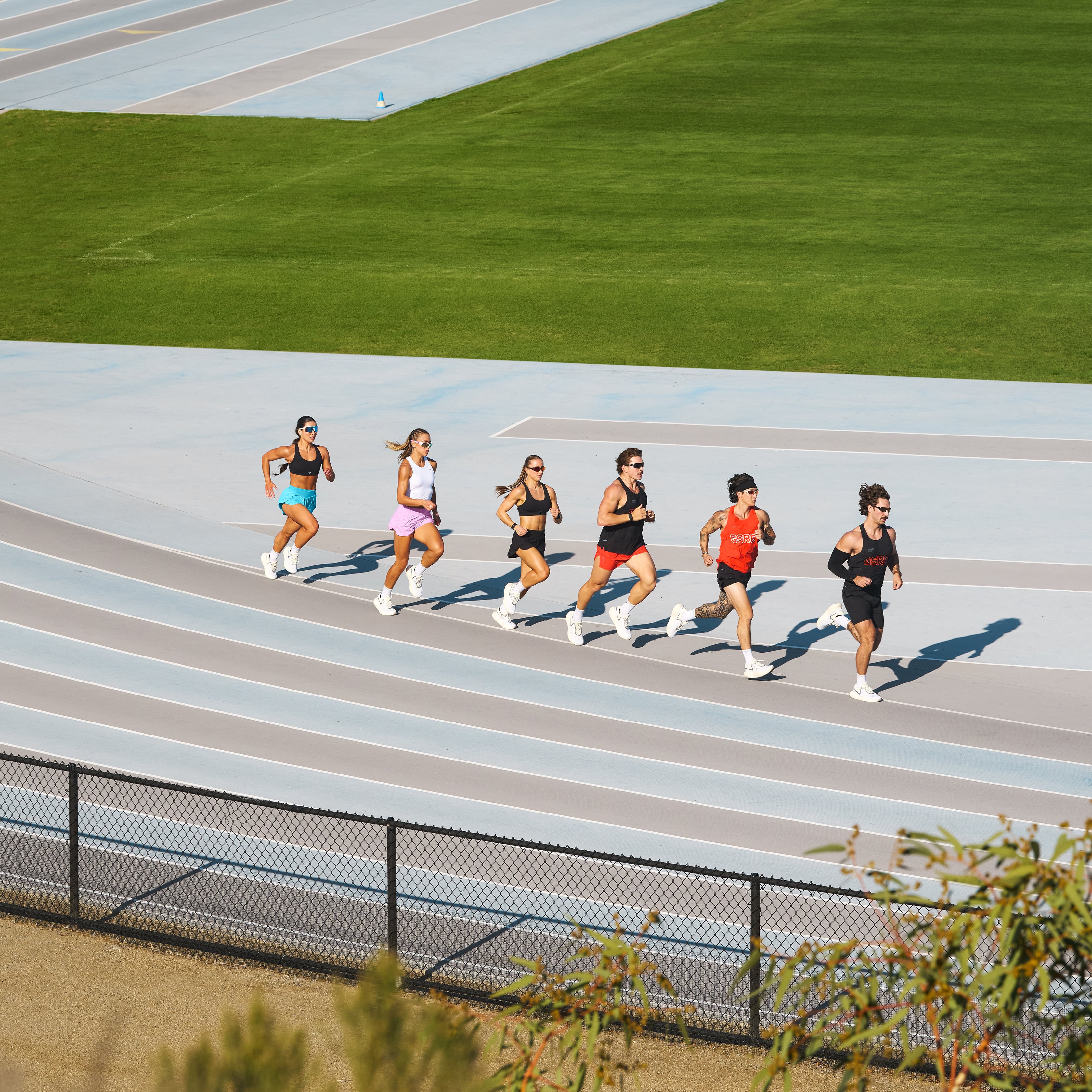
Increasingly, track running is being adopted by fun-seeking speedsters who are looking to track running clubs for the fast-paced social benefits. As well as making runs more exciting, it offers a chance to get involved with the local community and meet like-minded people.
How Long Is a Running Track?
A standard outdoor running track measures 400 metres per lap in lane one.
Because the distance is fixed, runners often use the track to structure workouts around specific lap counts.
1 lap = 400 meters
2 laps = 800 meters
4 laps = 1600 meters (roughly one mile)
10 laps = 4 kilometers
12.5 laps = 5 kiliometers
Tracks are divided into multiple lanes, and each outer lane is slightly longer than the one inside it. That’s why races typically begin with staggered starting positions, ensuring every athlete runs the same distance overall.
For training sessions, most runners stick to lane one or two when running intervals or steady efforts.
Why Train on a Track?
Accurate Pacing
One of the biggest advantages of training on a track is how easy it is to control your pace. A standard outdoor track measures 400 metres per lap, so you always know exactly how far you’ve run. That means not relying on GPS accuracy or guessing distances mid-run.
With clear markers every 100 metres, it’s easy to check your splits and learn what different paces actually feel like. Over time, this helps you build a stronger sense of rhythm and pacing, whether you’re running intervals, tempo efforts, or longer reps.
The environment also removes many of the distractions you get when running on the road. No traffic lights, uneven pavements, or busy crossings. Just a predictable loop where you can focus fully on your effort.
Ideal for Intervals and Structured Workouts
The track really shines when it comes to structured training. Faster sessions on your training plan, like intervals, tempo runs, or speed sessions, are a lot easier to execute on the track.
With intervals, the shorter distances mean you can focus on running hard during the work intervals and recovering properly between them without worrying about where to turn around or whether your watch has measured distance correctly.
Track sessions also build mental resilience. It takes some inner strength to run repeated laps while maintaining the same pace and effort, even when fatigue starts creeping in. It sounds simple, but it isn’t! But you slowly build the confidence and confirmation that you can, in fact, do it, and this kind of discipline carries over to race day and other areas of life.
Improves Running Form
Another benefit of the track is the surface itself, which is made of rubberised materials over an asphalt base. They offer far more grip and cushioning than concrete, and the even surface promotes efficient running mechanics.
It’ll have a slightly springy surface, which can make faster running feel more comfortable, while also reducing impact stress and strain on your joints.
And because you’re not constantly scanning for potholes, curbs, or pedestrians, it also becomes easier to concentrate on your form. Things like posture, cadence, and relaxed arm movement are much easier to focus on in a controlled environment like the track.
Builds Speed and Endurance
Track training is also one of the most effective ways to improve both speed and endurance. Intervals are high-intensity; think of it as HIIT on the track. You’re boosting both your anaerobic and aerobic capacity and improving your overall cardiovascular fitness.
You’re also raising your lactate threshold by regular interval training, meaning your body is learning how to clear lactate more efficiently, allowing you to maintain faster paces for longer before fatigue sets in.
The result? Faster running. The quicker turnover required during faster reps also activates fast-twitch muscle fibres, helping you generate more power and efficiency in your stride. For distance runners especially, that extra speed reserve can make a big difference when it comes to finishing strong.
Tips for Your First Track Session
If you’re new to track running, the key is to start simple and focus on learning the rhythm of structured workouts. It’s the difference in pace, intensity, and exertion that takes some getting used to, and a good track session starts with the prep:
When you start running on the track:
Warm up properly: Always begin with an easy jog (recovery or zone 2 pace) and a few running drills to prepare your muscles for faster efforts. Doing so raises your heart rate and activates the working muscles, so you have a lower chance of straining yourself when you actually get going.
Start slower than you think: Track workouts often feel manageable at first, but the intensity builds quickly. Starting slightly conservatively helps you keep up the effort rather than fading halfway round the track.
Focus on pacing: Because it’s easier to run at a consistent effort, it’s easier to pace yourself, too. Focus on your lap splits. It can be tempting, but try not to sprint your first repetition; it’ll skew your tracking if you can’t keep it up.
Take proper recovery: Walk or jog between efforts to allow your body to reset before the next repetition. Track sessions can be intense, so proper recovery is important for keeping your form up so each interval stays strong, not sloppy.
Add track sessions gradually: For most runners, one track workout per week is enough to see improvements. Track sessions place higher stress on the body, so spacing them out allows you to recover and continue progressing safely.
Track Running Workouts for Beginners
Most track sessions follow a simple structure: warm up, run a few drills, complete your intervals, then finish with an easy cool-down. The amount of time you spend running is probably a lot shorter than you’re used to, but that structure allows you to run faster while staying controlled and reducing injury risk.
It all begins with a proper warm-up and running through a few track drills to wake up the muscles you’ll rely on during the workout:
Warm-Up and Track Running Drills
Before jumping into track speed workouts, a proper warm-up is recommended. Speed work taxes the muscles and joints more than your easy miles, so your body needs time to prepare to remain injury-free.
Rather than standing still and static stretching (that can wait till the end), use dynamic movements that gradually extend your range of motion and activate the muscles. This is the foundation of dynamic track drills, movements designed to improve coordination, running mechanics, and velocity on the track.
Mobility and Activation
Start with some easy movement to get your heart rate up and loosen the joints.
A simple warm-up could include:
5–10 minutes of easy jogging
leg swings (forward and sideways)
hip circles
ankle rolls
walking lunges
jump squats
This stage simply helps shake out stiffness and prepares your body for the switch to faster movement.
6 Linear Track Drills To Perform In Succession
Linear drills focus on the forward movement used while running. They help improve knee drive, coordination, and stride rhythm. Perform these common track drills 1-2 times for around 20-30 metres before jogging back to recover:
1. Butt Kicks
How to do Butt Kicks:
Butt kicks are a simple but important drill for building rhythm and leg turnover.
The focus here is on bringing the heel up toward the glutes while maintaining an upright posture and steady forward movement. Keep your steps quick and controlled rather than exaggerated.
The goal isn’t to jump up and down. Instead, think about maintaining forward momentum while allowing the legs to cycle quickly underneath your body.
2. A-Skips
How to do A-Skips:
Next is the A-skip, which builds on the same positions used in walking high knees but adds a light bouncy rhythm.
You’re still aiming to drive your knee up to hip height, but now you’ll perform the movement with a slight skipping motion. Swing the same arm up as the skipping leg; they should move together at the same tempo.
There’s no extra movement after the knee lift. It’s clean, cyclical, almost like marching with spring.
The key cue here is where your foot lands. Your foot should come down directly underneath your hips, not behind you, and not reaching out in front. Landing under your body helps reinforce efficient running mechanics and keeps your stride powerful and controlled.
Cue: 👉 Knee up, foot down under hips.
3. B-Skips
How to do B-skips:
The next drill is B-skips, which often causes confusion because different coaches teach it differently.
Some people teach B-skips with a long leg extension that lands far in front of the body and drags backward. Overextending the leg too far forward turns the movement into a braking motion.
Instead, lift the knee up as you would in an A-skip, and keep the extension controlled and minimal. Then strike the foot down and pull it underneath your body quickly. Focus on snapping the foot down and ripping it back under the hips, rather than extending the leg out in front.
A-skip: Foot goes up → down
B-skip: Foot goes up → out → down → back
Extending the leg too far forward exposes the back side of the leg and can increase the risk of injury. Keeping the movement active and underneath your hips helps reinforce strong sprint mechanics.
Cue: 👉 Knee up → flick out → snap down and pull back.
4. C-Skips
How to do C-skips:
After A-skips and B-skips comes the C-skip, which is where many people struggle with rhythm.
The movement begins similarly to an A-skip, but instead of driving straight up and down, the leg moves up and slightly out to the side, creating the curved “C” shape that gives the drill its name.
As the leg moves outward, your arms should also move slightly to the side to provide counterbalance. From there, bring the leg back down underneath your hips just like the strike in a B-skip.
Again, the key point is that everything returns underneath your hips. When your foot lands in a strong, straight-leg position, the stiffness helps transfer force through the body and propel you into the next step.
5. Carioca
How to do the carioca:
The next drill is carioca, sometimes called the grapevine drill.
This is a lateral movement designed to open up the hips and improve coordination. Unlike the other drills, which focus on forward running mechanics, carioca challenges the hips and stabilising muscles in a sideways motion.
There’s not a lot of technical instruction beyond practicing the movement and finding a rhythm. Some runners pick it up quickly, while others need more repetition. Like any drill, the key is practice. The more you repeat it, the more natural it becomes.
6. Fast Legs
How to do fast legs:
The final drill is fast legs, which is designed to help your nervous system fire quickly as you approach top speed.
Start by choosing one leg to work with first. For example, if you begin with the right leg, that leg will cycle up and down while the other leg stays mostly straight and acts as support.
The moving leg should come up and then strike down underneath your hips, producing the force that moves you forward. The straight leg is not responsible for the power; it simply stabilises the movement.
A helpful way to start is by performing small toe taps with straight legs to establish rhythm. From there, lift the working leg and drive it down into the ground underneath your body.
After completing the drill on one side, switch and repeat with the other leg.
Finally, you can combine both sides by alternating fast legs, switching legs every step. A progression from there is double alternating, where you perform two reps on one leg before switching to the other.
The key reminder with this drill is that it’s not just about moving your legs quickly. The goal is to produce force into the ground so that each strike helps propel you forward down the track.
7. Lateral Running Drills
Although running happens mostly in a straight line, lateral drills also help strengthen the stabilising muscles around your hips and glutes.
Movements like side shuffles or lateral skips challenge balance and coordination, which can help improve overall track conditioning and reduce the risk of injuries caused by weak stabilising muscles.
5 Track Workouts To Try
1. Sprint the Straights, Jog The Curves
This is one of the simplest track speed workouts, and it’s a great introduction to interval-style training on the track. Instead of timing reps or counting distances, you simply use the natural layout of the track to control your effort.
The idea is straightforward: run fast on the straight sections of the track and use the curves as recovery. Because each straight is roughly 100 metres, you naturally alternate between effort and recovery every few seconds.
It’s an effective track session because those short bursts of speed help develop cadence and running mechanics (upright posture, slight forward ankle lean, eyes straight ahead), while the easy jog keeps your heart rate elevated.
You can run the curves and jog the straights, but many runners prefer sprinting the straights rather than the curves since running fast on a bend can place more stress on the knees and hips.
Example workout
Warm up with 5–10 minutes of easy jogging
Run fast along each straight (about 100m)
Jog the curves at an easy recovery pace
Continue for 6–10 laps of the track
Why it works
Builds speed and turnover without overly complex intervals
Improves running form through repeated fast strides
Keeps the workout controlled because recovery is built into every lap
For beginners, this workout is also helpful because it removes the pressure of hitting exact times or distances. You simply focus on effort: fast on the straights, relaxed on the bends.
2. 200m Repeats (Track Workouts for Speed)
Short, fast intervals like 200m repeats are great for improving leg turnover and top-end speed. Because the distance is relatively short, you can run each effort fast while still maintaining good form. Over time, this helps your body get used to moving quicker, which makes race pace feel easier.
Many runners use 200m repeats to develop finishing speed and improve their ability to change pace during races. They’re short enough to feel manageable but demanding enough to challenge your legs and lungs.
Example workout
6-12 × 200m of fast running
200m walk or light jog recovery
Why it works
Improves leg speed and running cadence
Develops finishing speed for races
Builds confidence running faster paces
3. Tempo Track Workouts for Distance Runners
Tempo running focuses on holding a steady, challenging pace for a longer effort. This type of training improves your lactate threshold, which is essentially how long you can maintain a strong pace before fatigue sets in. Doing tempo work on the track can help you stay consistent with pacing, especially if you're training for longer races. The difference on the road is that you’re pretty much guessing your effort and rhythm, especially with the uneven surfaces and elevation differences.
Example workout
3-5 × 800m at tempo pace*
90 seconds to 2 minutes recovery between efforts
Why it works
Improves pacing awareness
Builds speed endurance
Developed aerobic capacity
*Tempo pace is typically the pace you could sustain for about one hour of running. For most runners, that’s roughly 15–25 seconds per kilometre slower than 5K race pace, or a comfortably hard effort where you can speak in short phrases but not hold a full conversation.
4. Ladder Track Workouts (Intervals)
Ladder workouts are a favourite among runners because the distance changes with every rep. Instead of repeating the same interval again and again, you gradually increase the distance before working your way back down. This variation keeps the workout mentally engaging while still providing a challenging mix of speed and endurance. The shorter intervals allow you to run faster, while the longer ones build strength and stamina. After each effort, take an easy jogging recovery before moving on to the next distance.
Pace: A standard track ladder workout typically uses a 5K goal pace for longer intervals (800m-1600m) and faster, mile-pace to 3K pace, for shorter, faster intervals (200m-400m).
Ladder Workout: 200–400m easy jog recovery between reps
Run 200m, then recovery jog
Run 400m, then recovery jog
Run 600m, then recovery jog
Run 800m, then recovery jog
Run 600m, then recovery jog
Run 400m, then recovery jog
Run 200m, then recovery jog
Why it works
Keeps workouts varied and engaging
Develops both speed and endurance
Helps runners practise pacing across different distances
5. Pyramid Track Workout (Intervals)
Pyramid workouts are similar to ladder sessions but usually build to a longer middle interval before descending again. This structure challenges your endurance in the middle of the session while allowing you to finish with faster running as the distances shorten. Because the effort increases and then decreases, pyramid workouts help runners learn how to manage pacing while running on tired legs. After each effort, take an easy jogging recovery before moving on to the next distance.
Pace: Pyramid track workouts typically use 5K race pace or slightly faster.
Pyramid Workout: 200–400m easy jog recovery between reps
Run 400m, then recovery jog
Run 800m, then recovery jog
Run 1200m, then recovery jog
Run 800m, then recovery jog
Run 400m, then recovery jog
Why it works
Builds endurance and stamina
Improves pacing awareness
Balances speed and aerobic conditioning
Track Running Etiquette (Useful for Beginners)
Warm up off the main track.
Most runners do their warm-up jog and drills on the field. If you do use the track, stick to the outer lanes so the inside lanes stay clear for faster running. When in doubt, use the grass.
Keep lane one for faster running.
Lane one is usually reserved for runners doing speed work or intervals. If you're running easy laps or warming up, it’s best to use the outer lanes instead.
Use the outer lanes for slower running.
Jogging, walking recoveries, and cool-downs are usually done further out. It helps prevent faster runners from constantly having to weave around people.
Check before stepping onto the track
Just like crossing a road, it’s worth taking a quick glance before stepping into a lane. Someone might be approaching quickly during a sprint rep.
Run in the same direction as everyone else.
Tracks run in an anticlockwise direction, unless your run group does it differently. Following the same direction helps keep sessions predictable and avoids collisions.
Stay aware of your surroundings.
Don’t use headphones or your mobile phone on the track or infield. This is potentially dangerous and may stop you from hearing other track users or safety announcements.
Move aside when you stop
If you need to tie your shoe, stretch, or catch your breath, step off the running lane so others can continue their session without interruption.
Common Track Distances Runners Train With
Sprints
100m sprint: High-power and explosive distance used to increase power, speed, and acceleration. Often used in race settings.
200m (Half Lap): Often used for speed development, stride work, or as part of a HIIT session. These shorter reps appear frequently in track speed workouts or as part of interval sessions.
400m (One Lap): Probably the most common interval distance. Repeating 400m efforts is a great way to build speed endurance while still keeping the session manageable. Often ran in 8-10 reps.
Middle-Distance
600m (1.5 Laps): Frequently used in ladder workouts (e.g., 200-400-600-400-200). A useful middle-ground distance - long enough to challenge endurance but still short enough to maintain a strong pace.
800m (Two Laps): A staple for middle-distance and long-distance runners to improve aerobic capacity and pacing control.
1200m (Three Laps): Used for strengthening, often as part of pyramid workouts (e.g., 400-800-1200-1600). Pushes endurance while remaining sustainable.
1600m/1 Mile (Four Laps): Used for goal-pace training, usually done with 400m recovery. Also used for race-pace training, especially for runners preparing for 5Ks, 10Ks, or longer events.
Long-Distance
3000m/5000m (7.5 - 12.5 Laps): Longer track efforts are usually used by advanced runners for endurance training.
FAQs
Can I use track running for marathon training?
Yes, the track is an ideal place to run during marathon training. While you’ll pick up the mileage with longer runs, you’ll also need to include speed work and tempo runs, and the track is a great place to build speed, efficiency, and pacing control. Mid-distance track workouts like 400 - 800m intervals help improve your aerobic capacity and make marathon pace feel more comfortable.
Is track running good for beginners?
The track is one of the most beginner-friendly places to run because the environment is predictable and the distances are clearly marked. You always know how far you’ve run, which makes it easier to structure workouts and track progress. Plus, there’s no worrying about dodging traffic or navigating unfamiliar routes to think about.
How many laps is a mile on a track?
On a standard 400m outdoor track, one mile is just over four laps. Four full laps equals 1600m, which is very close to a mile (1609m).
How often should I run track workouts?
One track session per week is a good starting place for most runners. This allows enough time to recover between sessions while still gaining the speed and endurance benefits of interval training. An example running schedule could be: Monday - Track, Wednesday - Tempo Run, Friday - Easy Run, Sunday - Long Run.
Do I need spikes to run on a track?
No. Regular running shoes work perfectly well for most training sessions, particularly if they are lightweight and have thinner soles (like racing flats). Track spikes are usually only necessary for competitive racing or very fast sprint workouts.
Final Thoughts
Track running is one of the best ways to improve your speed, pacing, and endurance. You know exactly what you’re getting at track: a smooth surface, a controlled environment, and consistent distance lap after lap.
Start simple when you first start out, choose one interval workout, and focus on keeping a controlled pace each time you run a lap. Gradually build your volume over time and prioritise consistency over maximum effort.
Track running can also be a surprisingly fun and social way to train. Many runners join local track nights or run clubs where interval sessions are done as a group. Sharing the session with others can help keep motivation high, add a bit of friendly competition, and make tough workouts feel more enjoyable.
And when it comes to speed work, there’s no better place to train than the track. Interval training will help you run faster, build endurance, and leave each session feeling like you’ve made real progress. So when race day comes around, you’ll have the confidence to pick up the pace.