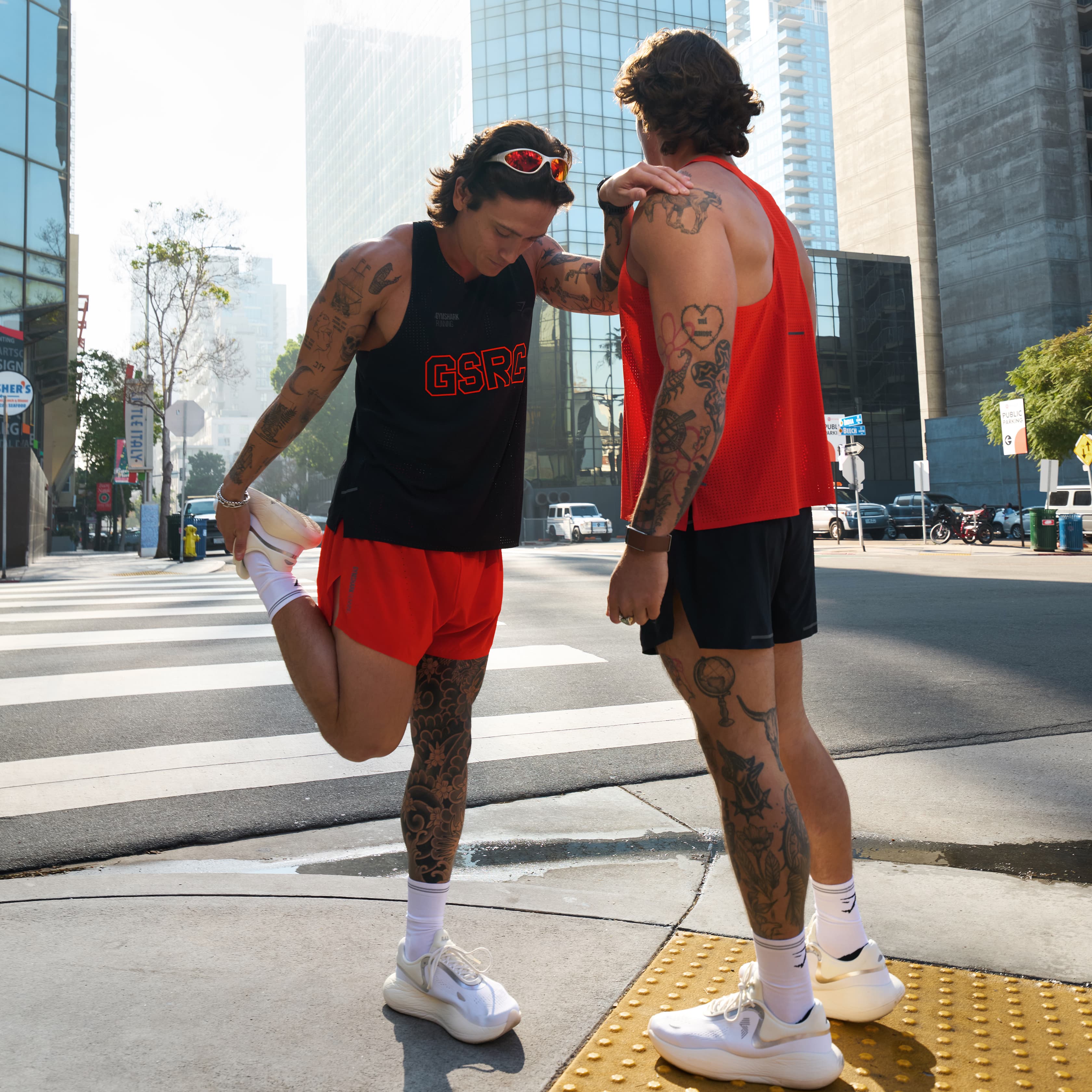
















For years, running treadmill workouts had the reputation of being the run you ‘save for a rainy day’. Or it was how you got your running in when the weather turned bad, your favorite running route was covered in snow, or you simply couldn’t face the wind chill and cold at 6 am.
Now, treadmill workouts are a regular tool in many runners’ routines. For beginners, especially, it can be a place where you can learn pacing without the pressure of unpredictable terrain and build confidence away from busy pavements. For others, it’s the key to consistency and stacking miles - and getting your interval runs in - when life's schedule gets a little chaotic.
But that’s not to say it isn’t different; the moment the belt starts moving, you can instantly feel it. And that’s because it is different. But different doesn’t mean worse; it just means running with more control: control of your pace, speed, and environment.
Here’s your guide to running smarter indoors and turning treadmill time into something you look forward to, not tolerate.
How Is Running On A Treadmill Different To Outdoor Running?
Running Rhythm Is Altered
Running on a treadmill is still running, but it does land differently on your body compared to heading out on the road or trails. Besides the lack of natural breeze, a lot of runners talk about the belt creating a slightly different rhythm. This is because the treadmill holds a fixed pace. Your stride and cadence don’t get to ebb and flow the way they naturally do outside, which can feel like the treadmill is setting the rhythm for you, rather than you finding it naturally yourself.
Muscles Engage Less Due To Added Resistance
The biomechanics of running are also altered. When you’re outside, you generate forward momentum by pushing off the ground, engaging the hamstrings and glutes with each stride. But on a treadmill, your foot is pushing off a moving belt, creating a slight pull that changes how your muscles fire [1]. It can feel easier, but at times, like your muscles are engaging less.
Stride Length Can Shorten
On the belt, you also tend to run with a shorter stride length and slightly higher cadence, which can actually be a good thing - it means you’re taking quicker, lighter steps, landing your foot closer to your body (under your center of gravity) and reducing force impact. Because of this more compact stride pattern and the treadmill’s cushioned surface, treadmills are commonly used in rehabilitation and return-to-sport programmes where taking it slow and limiting impact are priorities [1].
Perceived Effort Changes
Perceived effort is another big one in terms of the differences between the two run types. Many people say the same pace feels tougher outside because of real-world considerations like changing terrain, wind, and constant micro-adjustments. Others say the reverse, and find treadmill running feels harder because of the monotony, lack of stimuli, and awareness that one wrong move could send you flying.
Research has also shown that treadmill running can cause dehydration faster than outdoor running because the heat dissipates less efficiently. No natural breeze = less sweat evaporation. It’s why even an easy treadmill run can feel spicier than expected [2].
Key Takeaway: Treadmills give you a controlled, predictable environment, but that control can change the way the run feels mechanically, mentally, and physically. Don’t expect your treadmill runs to mirror your outdoor ones. Both types of run help to build your cardiovascular fitness and get better at running, so when you embrace the differences, you can get the most out of the belt.
💡Treadmill workout tip: Most people also wonder if treadmill workouts are easier or harder than outdoor running. Both use your cardiovascular engine to work through your gait cycle, and studies show that the metabolic demand between treadmill and outdoor running is almost identical… almost.
Running outdoors means you’re always subtly working against air resistance. But setting the incline to 1% best replicates the energy cost of running outside because it mimics the missing resistance. If you keep the treadmill flat, it can feel easier simply because there’s no air pushing back at you. Set it to 1% and you get that real feel [3].
The Best Treadmill Workouts for Running
One thing about treadmill workouts, and something that most definitely trumps outdoor running, is that they’re incredibly precise. Outdoors, your place fluctuates; on the treadmill, your pace holds. That gives beginners confidence to know what a certain pace feels like and stick to it. And for experienced runners, it offers control when needed and structure to hit intervals and tough training blocks in their marathon blocks without worrying about finding the nearest hill or suitable run route.
Here are the best treadmill workouts to try for every level. And if you have a specific distance you’re training for? Why not discover a full training plan for your run (for free) below? Hint… you can still use the treadmill 👇
A Warm-Up That Actually Works Indoors
You still need your muscles to warm up before finding your pace, even if you are staying indoors.
Once you’ve moved through dynamic stretching, walk for 4-5 minutes at a comfortable pace, then gradually increase the pace until you reach a light jog, before finding your set pace. Treadmills heat you up faster, so you won’t need as long to feel ready.
Hit the cooldown button at the end of every run to finish with a 2-3 minute easy walk, slowing your heart rate and letting your feet adjust from a moving belt to more solid ground.
Beginner Treadmill Workouts
30-Min Walk/Run Intervals
This style of treadmill running is a great confidence builder for beginners. You’ll alternate between controlled bursts of jogging and restorative walking phases.
The Workout:
For beginner treadmill running, start with a comfortable jogging pace between 4-6 mph (6.4-9.6 km/h)
Run for 1 minute, walk for 2 minutes.
Run pace: 4–6 mph (6.4–9.6 km/h)
Roughly 9:20–6:15 min/km
(RPE 4–5 | HR 65–75% max | Zone 2)
Walk pace: comfortable (RPE 2–3 | HR <65% max | Zone 1)
Repeat 10 times.
If you feel comfortable, increase the incline by 0.5-1 percent for the final stint.
Progressive Runs
Start at a very easy jogging pace, then build gradually.
The Workout:
10 minutes at an easy effort (RPE 2–4 | HR 60–70% | Zone 2)
10 minutes at a steady effort (RPE 5-6, HR 70-80%, Zone 2/Low Zone 3)
5 minutes slightly faster (RPE 6-7, HR 80-85% | Zone 3)
The goal isn’t speed; it’s about getting a feel for how pace changes feel under your feet.
What RPE means:
RPE stands for Rate of Perceived Exertion. It’s a simple 1–10 scale that describes how hard the run feels. A low RPE means you could keep going comfortably; a higher RPE means the effort feels challenging but controlled.
A quick reassurance:
If Zone 2 feels slow at first, that’s completely normal. For many beginners, it can sit somewhere between a brisk walk and a very gentle jog. With consistent running, your heart rate will drop at the same pace over time, and that “easy” zone will naturally start to feel faster.
Intermediate Treadmill Workouts
Easy Runs
Hop on the treadmill, warm up, then up the speed to your easy pace in Z2 (remember, you should be able to have a conversation at this pace - running on a treadmill might make things feel easier, but it shouldn’t change your pace), and get running.
Example:
Warm Up: 10 minutes easy (RPE 3–4 | HR 60–70% | Zone 2)
Main run: 6 km easy
Pace: ~6.4 mph (10.3 km/h)
Roughly: 5:50 min/km (RPE 4–5 | HR 65–75% | Zone 2)
Cool Down: 10 minutes easy (RPE 2–3 | HR <65%)
Interval Running
Alternating between high-intensity bursts and recovery periods makes you faster, fitter, and improves your V02 max by stressing cardivascular system more than regular running. These sessions are a staple in most structured training plans, often appearing in speed, 5K, or half-marathon training blocks, where the focus is on improving VO₂ max, leg turnover, and tolerance to harder efforts. Over time, interval running teaches your body to recover more efficiently between surges, which carries over to race day and longer runs, too.
Example:
Warm Up: 10 minutes easy pace (RPE 3–4 | HR 60–70% | Zone 2)
4 x 4 minutes at a “comfortably hard pace” (RPE 7–8 | HR 85–90% | Zone 4)
Follow with 2 minutes recovery jog and repeat (RPE 3–4 | HR 65–70% | Zone 2)
Cool Down: 5 minutes easy (RPE 2–3 | HR <65%).
Set the incline to 1% for the entire workout.
Tempo Block Run
This is where the controlled pace that treadmills offer truly shines. Tempo block runs are where you warm up, then run a continuous block in the middle at a “comfortably hard” pace about 25-30 seconds slower than your 5K race pace, followed by a cool down.
The Workout:
Warm Up: 10 minutes easy pace (RPE 4–5 | HR 65–75% | High Zone 2).
20 minutes controlled tempo (RPE 6–7 | HR 80–88% | Zone 3).
Cool Down: 5 minutes easy (RPE 2–3 | HR <65%).
Hill Sprints
Short, spicy and very effective, hill sprints build explosive power in the legs, speed, and improve running economy and cardiovascular fitness. That explosive strength carries over into faster acceleration and stronger finishes at the end of races and better performance in hybrid training and field-sports that require quick bursts of power.
Treadmills are also great for hill work because the incline is instant, consistent, and safe. There’s no hunting for the “right” hill, no uneven footing, and no traffic to worry about. You can focus purely on effort and form, then step straight into recovery without the impact of running back downhill.
Example:
Warm Up: 10 minutes easy pace (RPE 4–5 | HR 65–75% | High Zone 2).
8 x 20 seconds at a fast effort (RPE 8–9 | HR 90–95% | Zone 5).
Incline: 6-8%
Jump your feet to the side to recover for 60 seconds or lower the speed to a walking pace (RPE 2–3 | HR <70%).
Repeat 8 times.
Cool Down: 5 minutes easy (RPE 2–3 | HR <65%).
Advanced Treadmill Workouts
Threshold Sandwich
A favourite among distance runners. A threshold sandwich is a running workout that mixes threshold and speed. Threshold work helps raise the pace you can sustain comfortably for longer, making it perfect for 10K to marathon training.
The Workout:
Warm Up: 5 minutes easy pace (RPE 2–3 | HR <65%).
10 minutes steady (RPE 5–6 | HR 75–82% | Upper Zone 2)
20 minutes threshold pace (roughly 10K pace, RPE 7–8 | HR 88–92% | Zone 4)
10 minutes steady (RPE 5–6 | HR 75–82%)
Cool Down: 5 minutes easy pace (RPE 2–3 | HR <65%).
Keep incline at 0.5–1%
Long Progression Run
This is likely your big run of the weekend - a continuous run that builds endurance, stamina, and aerobic strength. You’ll move through gears gradually until you finish at a strong, confident pace. Long runs use the treadmill’s precision to teach your legs to stay relaxed as the miles accumulate, while the small pace changes help keep your brain alert and prep your body for late-run fatigue, without the unpredictability of outdoor terrain.
The Workout:
Warm Up: 20 minutes easy (RPE 3–4 | HR 60–70% | Zone 2).
20 minutes steady (RPE 5–6 | HR 70–80% | Zone 2–3).
15 minutes strong (RPE 7 | HR 80–88% | Zone 3).
5 minutes fast finish (RPE 8 | HR 88–92% | Zone 4).
Cool Down: 5 minutes easy pace (RPE 2–3 | HR <65%).
Race-Pace Practice Run
Nothing beats the treadmill for practicing your target race speed, and it’s the true test of whether you can maintain it. This session teaches you exactly how race pace should feel: controlled, consistent, and sustainable. No wind. No terrain. Just you and the belt.
The Workout:
Warm Up: 10 minutes easy (RPE 3–4 | HR 60–70%)
Race pace block: 15–20 minutes at your goal race pace
5K race practice: 10–12 minutes at race pace (RPE 8–9 | HR 90–95% | Zone 4–5)
10K race practice: 15 minutes at race pace (RPE 7–8 | HR 88–92% | Zone 4)
Half-marathon practice: 20 minutes at race pace (RPE 6–7 | HR 80–88% | Zone 3)
Followed by 5 minutes steady running (RPE 5–6 | HR 75–82%)
Cool Down: 5 minutes easy pace (RPE 2–3 | HR <65%)
How to Pace Your Treadmill Runs
Pacing yourself on a treadmill starts with your expectations. Outdoor pace and treadmill pace are cousins, not twins. Running outside can feel drastically different from running inside; your pace shifts naturally with terrain, wind, heat, and route changes. Indoors, the pace is fixed - but even treadmills differ from one another. Belt quality, cushioning, incline calibration, temperature, and even how frequently the machine is serviced can make you feel fast on one treadmill and sluggish on another.
Because of this, finding your true treadmill pace takes practice.
Here are a few pacing strategies to help:
1. Use perceived effort, not just numbers.
The mph and km/h on a screen don’t always translate to how the pace actually feels. Your body can provide as much pacing data as a display.
You can measure your perceived effort by your:
Breathing
Easy = breathing steady and controlled.
Tempo = breathing deep but manageable.
Speed = breathing sharp and rhythmic.
Conversation test:
Easy = full sentences, can keep up a conversation.
Steady = short sentences between deep breaths.
Hard = single words, focus is on the breathing.
How your legs feel:
If the belt feels like it's dragging your legs behind you or you can’t settle into a rhythm, that’s a clue that the pace is probably too high.
Adjust your running to the treadmill’s feel and your perceived exertion, rather than forcing an outdoor pace. Then pair this with a 1% incline if you want your treadmill workout effort to closely match the resistance of running outdoors.
2. Expect the “treadmill temptation” to creep in.
Seeing your pace on a screen in front of you makes it way too easy to overestimate your ability and go too fast, too soon. Many runners unintentionally drift too fast during treadmill easy runs because the belt feels smoother than the pavement. Sound like you?
Here’s how to avoid this:
Keep your ego in check by starting 0.3–0.5 mph (0.5–0.8 km/h) slower than your normal easy pace.
Ease into the run and use the first 5 minutes as a “calibration period.”
If you’re following a structured workout, set the pace for the run, and stick to it.
If an “easy” treadmill run turns into a tempo run by accident, you're setting tomorrow’s session up for fatigue.
3. Use incline for a realistic feel.
0 percent will always feel slightly easier because there’s no wind resistance or terrain variation. If you want an outdoor-equivalent run, set the incline to 1%. Use 2-10% for hill training to target the glutes, calves, and hamstrings more aggressively.
4. Use heart rate zones and RPE to structure runs reliably.
Treadmills are ideal for zone-based training because the base stays exactly where you set it, even if your stride slows down or speeds up. Use this to your advantage when it comes to structuring your runs [5].
Pacing basics:
Easy runs/long runs (Zone 2 / RPE 2–4): You should feel relaxed, smooth, and able to run continuously for a long time (your long run time). There should be no tension in the shoulders, and your breathing should be fairly steady. If your HR is climbing fast, reduce the pace.
Tempos/race effort (Zone 3 / RPE 6–7): Strong, steady, and controlled. You should definitely feel an increase in effort here - like you’re working but not straining. This is a comfortably hard effort, which may feel tougher outside than on the treadmill, as you can hold the rhythm with less drift and fatigue.
Speed work (Zone 4–5 / RPE 8–9): Short fast intervals are the pace that requires clear focus and agility. Your heart rate is higher, and so is your effort. Make sure you’re fully warmed up; treadmills can feel punishing at high speeds without preparation.
Treadmill Running Form Tips
Form matters even more indoors because the belt gives you immediate feedback. Good posture makes the run feel smoother, more natural, and far less tiring.
Keep your head and neck relaxed: Look forward, not down at your feet. Your spine will thank you, and your stride rhythm will stay more consistent.
Aim for a naturally quick threshold: Somewhere in the 165-180 steps per minute range. If you don’t have a fitness tracker, just choose a pace where your steps feel light and rhythmic instead of long and heavy.
Avoid overstriding: Your foot placement is everything. The belt moves underneath you, so striding too far forward with your foot can throw your balance off. Keep your feet landing under your hips (your centre of gravity).
Arm swing relaxed: Keep your elbows relaxed and close to your body, letting your arms swing. Don’t grip the sides; it limits your natural movement and puts pressure on your shoulders.
Use a safety clip if you’re new: If you’re still getting comfortable on the treadmill, clip the safety cord to your clothing. If you stumble or drift too far back, it automatically stops the belt. It’s there to help you feel secure while you find your rhythm, and don’t worry, no one’s watching and no one’s judging.
How To Stay Motivated on the Treadmill
Use entertainment intentionally.
Don’t underestimate the power of endorphins for your motivation. Put on a podcasts that make you laugh and watch how the miles fly by. Or series you can watch without missing plot twists and playlists that turn intervals into mini music videos. Music works especially well for structured tempo and interval runs because you can choose tracks with a strong, steady beat that matches your target cadence, making holding your pace feel smoother and more automatic. There are actually plenty of ready-made running playlists designed around BPM so you can let the rhythm do some of the pacing for you.
Break your run into blocks.
Even a long run feels lighter when you mentally split it into chapters. Break it down into doable chunks for your brain, like 3km x 3 times. Or every 5–10 minutes, change something up - your pace, incline, focus, posture.
Play with destination running.
Search YouTube or set the display to scenic run-along videos: mountains, cities, trails. It keeps the brain engaged and not just staring at the moving numbers on the screen.
Cover the screen.
Seriously. Throw a towel/t-shirt over it. Feel genuinely present as the minutes pass, instead of counting every second. If you’re completing a run where you need to change pace or complete intervals, just make sure you have a smartwatch to be able to tell you when your time is up!
Wear something you feel good in.
Lightweight running leggings, breathable sweat-wicking tees, cushioned running socks, running shorts that don’t ride up, and a supportive sports bra. Treadmill running is warm, and it can sometimes feel exposed in a busy gym, so you want to feel comfortable and confident in your kit.
Treadmill Running: Pros and Cons
Every runner has an opinion about treadmill running, often shaped by one particularly dull session or a forced treadmill run after an unexpected weather turn. But the truth about treadmill running is nuanced, so here’s a clearer look at what treadmills genuinely offer and where they fall short.
The pros
A treadmill gives you a fully controlled environment, meaning no wind trying to push you backwards, no rain soaking your shoes, no traffic, and no unpredictable terrain interrupting your run.
It allows for extremely precise pacing because the speed stays exactly where you set it, making it ideal for tempo runs, interval sessions, or practising race pace.
The cushioned belt provides a more joint-friendly surface than most pavements, reducing impact and helping you accumulate recovery miles with less strain[6].
Holding specific heart-rate zones is easier indoors because the pace stays steady, which is especially helpful for zone 2 training. Many runners struggle to keep their effort low enough outside, where slowing down can feel awkward or too slow, but the treadmill makes that controlled, easy pace far more achievable.
For time-pressed days, treadmills are great. When you’ve only carved out a tight 30-minute window, you don’t need to plot a route or worry about traffic; you just step on, start running, and you can still make your plans afterwards.
Many beginners feel safer and more confident on a treadmill thanks to the predictable surface, easy access to water, and the ability to stop instantly if something feels off.
For anyone marathon training through winter, a treadmill becomes a weatherproof lifeline that keeps your long-run routine intact.
It also helps slow down shoe wear, offers built-in entertainment if you pair it with Netflix, and provides a safe space free from cars, dogs, and unexpected interruptions.
And the cons?
The treadmill isn’t the perfect substitute for outdoors. Because the belt moves underneath you, you recruit fewer stabilizing muscles than you would outside, which can slightly reduce natural strength development.
The repetitive motion of treadmill running can lead to overuse issues if you spend long periods at the same pace or use the treadmill for high-volume training without variation [7].
Mentally, treadmill running can feel tougher because the scenery never changes, and the minutes can feel slow. You have to create your own entertainment and dig deep for motivation.
Treadmills vary widely in quality, so one might feel bouncy and forgiving while another feels heavy or poorly calibrated, sometimes it can take a few sessions to understand a new machine’s personality.
Heat builds up quickly without outdoor airflow, making easy runs feel harder than expected, causing sweat levels to spike and fatigue to creep in faster than it would outside.
How Often Should You Do Treadmill Runs?
This depends entirely on your goals, your routine, and what feels good for your body.
If you’re training through winter, you might lean on the treadmill for two to three runs per week, then head outdoors for your long run (if you can brave the cold). If you’re building speed, you might choose the treadmill for your interval sessions because of the pace precision. If safety is an issue (dark early mornings/evenings in winter, or isolated locations), then the treadmill becomes your saving grace.
But to avoid overuse injuries, try to keep some variety in your programme. Don’t just get on the treadmill and press start every time. Mix inclines. Mix speeds. Mix indoor and outdoor runs when you can. Don’t increase your mileage too quickly, especially on a treadmill, where repetitive mechanics can take a toll on your muscles and joints. Progressive overload applies to running, too!
Treadmill Workout FAQs
Is treadmill running accurate?
Treadmills can be very accurate for distance and pace because they measure how many times the belt rotates, and most well-maintained machines stay within a small margin of error when calibrated correctly. Modern treadmills, especially commercial or quality home units, typically track distance within about 1–2% accuracy because the belt length and rotation are known quantities [8].
However, accuracy isn’t perfect on every treadmill. Older or poorly serviced machines can drift out of calibration and skew distance and pace by a few percent.
Watches and fitness trackers add another layer of uncertainty when running indoors. Outside, they use GPS, which is usually quite reliable, but on a treadmill, GPS can’t work. Instead, they rely on arm movement and internal sensors to estimate distance and pace, which often leads to discrepancies. Runners frequently note that their watch and treadmill show very different splits and distances during the same indoor run.
Research also shows that treadmill-based measurements can differ from outdoor movement patterns, meaning devices calibrated using treadmill data may misestimate actual speed or energy expenditure when compared with overground calibration [9].
For practical training, the treadmill’s own distance and pace are usually more consistent than a smartwatch’s indoor estimate. It all goes back to treating treadmill running as different, not better, not worse, just different.
What incline should you use on a treadmill?
It depends on the type of run you’re doing. As we mentioned earlier, 1% incline works for most ready and steady runs if you want to replicate the mild resistance of running outdoors. 3-10% work for hill sprints, but steep climbs (above 10) should be used sparingly to avoid overloading your calves and Achilles.
What’s the best treadmill speed for beginners?
A comfortable beginner pace usually sits between 4-5mph (6.4-9.6 km/h), but it’s less about the numbers and more about whether you could hold a conversation while running. To test this, why not buddy up with a friend and run next to each other while trying to maintain a back-and-forth chat while running. Start slow, especially if you’re new or nervous to get used to the belt, then bump the speed up in tiny increments until it feels smooth and sustainable.
Is it OK to do all your training on a treadmill?
Yes, you can complete an entire training block indoors. Plenty of runners prepare for races almost exclusively on treadmills, especially during winter. The trick is to mix in inclines, vary your pace, and give your legs some strength work to keep stabilizer muscles engaged and keep injury-free. If you’re training for a race, adding at least a little outdoor running now and then helps you adapt to terrain and pacing shifts. You’ll be grateful for the change of scenery!
Does treadmill running build speed?
Treadmills are probably one of the best ways to build speed, in fact. They’re brilliant for intervals, tempo runs, and sprints because you can lock in a pace and hold it, no unexpected hill around the corner to slow you down. The belt also encourages quicker leg turnover, which can translate into faster outdoor speeds when paired with regular strength and form training.
What shoes should I wear on a treadmill?
Go for a lightweight running trainer, the ones you use for daily training. You don’t need deep traction or aggressive outsoles since there’s no terrain challenge on a belt, but you still want good cushioning and support. Make sure your shoes feel stable, supportive, and comfortable for longer stints.
Carbon plates? Not necessary for your everyday training on a treadmill.
Are treadmills good for long runs?
The treadmill can be a surprisingly powerful ally for recovery runs or easy long-run mileage. Because the deck absorbs more impact than the road, you tend to clock the distance with less stress on your legs. But the perks don’t stop there - it keeps you dry and warm, you don’t need to dodge cars or foot traffic, and if something doesn’t feel right, you’re one step from the stop button rather than miles from home (toilet breaks, anyone).
It even protects your shoes from wearing down as quickly. With bottle holders, Netflix, and zero logistical faff, it’s one of the simplest ways to get consistent mileage in. Just make sure you still bring your hydration and energy gels/chews with you, as it will feel warmer than your everyday outdoor run.
Final Thoughts
You don’t need to replace outdoor miles with treadmill running; both are great training tools to have in your running toolkit. Treadmills for precision, reliability, and a level of consistency you’ll never get outside. Once you stop comparing the belt to the pavement and start using each for what it does best, and what you like best, your running becomes more adaptable, varied, and enjoyable.
Beginners gaining confidence, seasoned runners refining pace, and busy athletes finding pockets of time all benefit from the treadmill. Pace set, incline chosen - let the belt be part of your strategy, not a fallback.
References
Nigg, B.M., De Boer, R.W. and Fisher, V. (1995) ‘A kinematic comparison of overground and treadmill running’, Medicine and Science in Sports and Exercise, 27(1), pp. 98–105. Available at: https://pubmed.ncbi.nlm.nih.gov/7898346/
van Hooren, B., Fuller, J.T., Buckley, J.D., Miller, J.R., Sewell, K., Rao, G., Barton, C., Bishop, C. and Willy, R.W. (2020) ‘Is motorized treadmill running biomechanically comparable to overground running? A systematic review and meta-analysis of cross-over studies’, Sports Medicine, 50(4), pp. 785–813. doi: 10.1007/s40279-019-01237-z. Available at: https://pubmed.ncbi.nlm.nih.gov/31802395/
Maughan, R.J. and Shirreffs, S.M. (2010) ‘Dehydration and rehydration in competitive sport’, Scandinavian Journal of Medicine & Science in Sports, 20(Suppl. 3), pp. 40–47. doi:10.1111/j.1600-0838.2010.01207.x. Available at: https://pubmed.ncbi.nlm.nih.gov/21029189
Jones, A.M. and Doust, J.H. (1996) ‘A 1% treadmill grade most accurately reflects the energetic cost of outdoor running’, Journal of Sports Sciences, 14(4), pp. 321–327. Available at: https://www.tandfonline.com/doi/abs/10.1080/02640419608727717
Zhou, Y., Chen, J.G., Li, X.L., Pan, X.L., Zhou, Y.Z., Li, Z.A., Liang, Z.C., Long, J.M., Qin, M.Z., Zhang, J., Shi, B., Wan, B.J., Chi, A.P., Zhu, W.F., Ning, K. and Sun, Y.L. (2021) ‘Biomechanical differences between treadmill and overground running: A systematic review’, Sports Medicine – Open, 7, Article 38. Available at: https://link.springer.com/article/10.1007/s42978-021-00138-w
Videbæk, S., Bueno, A.M., Nielsen, R.O. and Rasmussen, S. (2015) ‘Incidence of running-related injuries per 1,000 hours of running in different types of runners: A systematic review and meta-analysis’, Sports Medicine, 45(7), pp. 1017–1026. Available at: https://pubmed.ncbi.nlm.nih.gov/25951917/
Barnett, A., Cerin, E., Vandelanotte, C., Matsumoto, A. and Jenkins, D. (2015) ‘Validity of treadmill- and track-based individual calibration methods for estimating free-living walking speed and VO₂ using accelerometry’, Journal of Sports Sciences, 33(4), pp. 414–422. Available at: https://pubmed.ncbi.nlm.nih.gov/26613044/
Alibaba Insights (n.d.) Apple Watch vs treadmill distance: why is my Apple Watch so off and which one is right? Available at: https://www.alibaba.com/product-insights/apple-watch-vs-treadmill-distance-why-is-my-apple-watch-so-off-which-one-is-right.html
Barnett, A., Cerin, E., Vandelanotte, C., Matsumoto, A. and Jenkins, D. (2015) ‘Validity of treadmill- and track-based individual calibration methods for estimating free-living walking speed and VO₂ using accelerometry’, Journal of Sports Sciences, 33(4), pp. 414–422. Available at: https://pubmed.ncbi.nlm.nih.gov/26613044/