















It’s arm day; You’re training biceps and doing bicep curls – arguably one of the most well-known arm exercises out there.
If you're looking for the best arm exercises to take your arm workouts up a notch, you've come to the right place. But we’ll let you in on a secret – your biceps only make up one-third of your arm, and obsessing over this muscle on the front of your arm could jeopardise arm size and strength development.
So, what muscles should you target along with the biceps? One obvious choice is the triceps. These contain more muscle mass than the biceps, making them essential for creating bigger and more sculpted arms.
The third (and often most forgotten) muscle group is the forearms: These muscles of the lower arm are responsible for the movement and stabilization of the wrist, fingers, and thumb, and importantly, play a key role in grip strength.
If you want to lift heavier, stay injury-free, and build evenly developed arms from top to bottom, your arm workout should focus on bicep, tricep, and forearm exercises. We’ve handpicked the best exercises to do just that.
What Muscles Make Up The Arms?
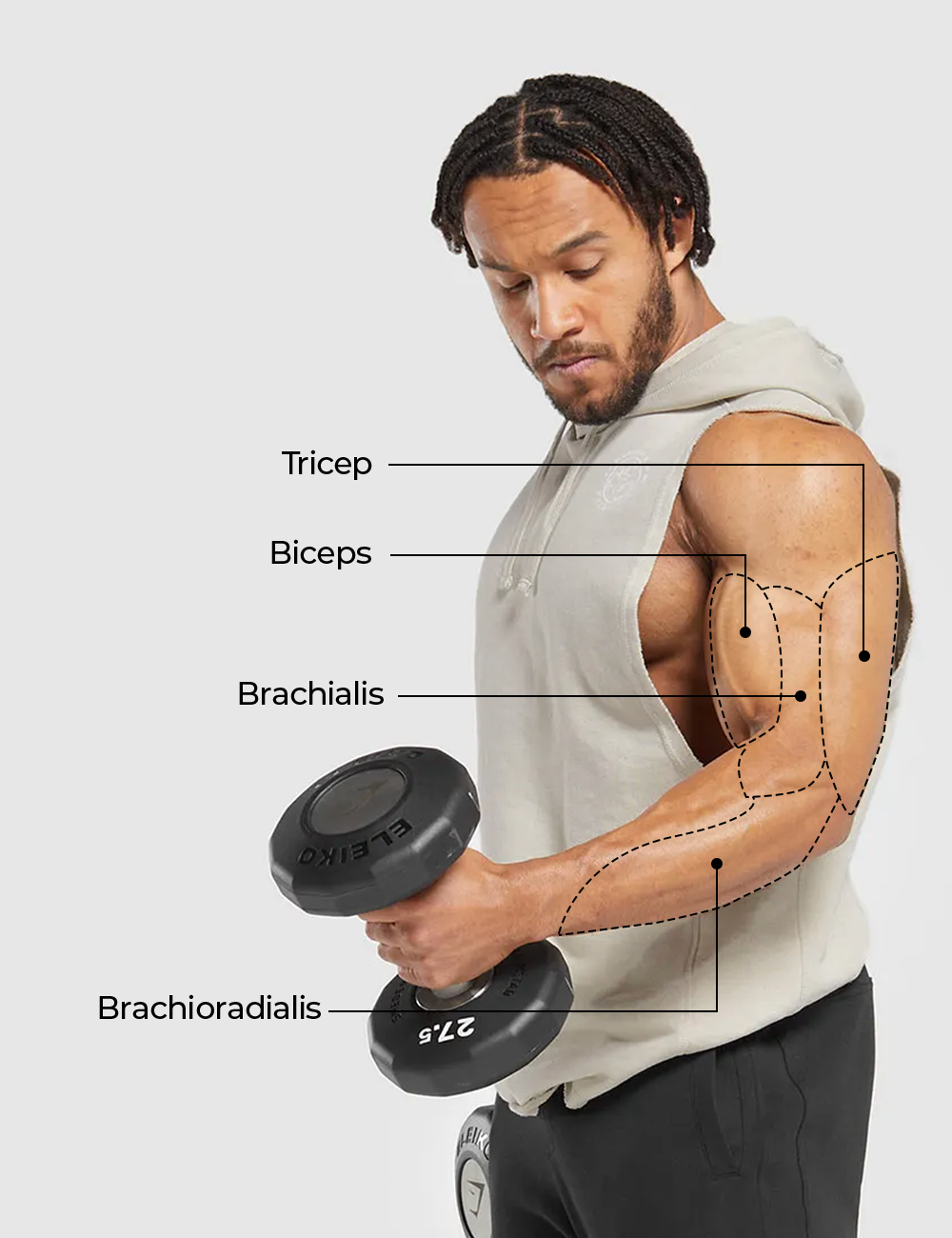
Before we delve into the best arm exercises for your next arm workout, let’s take a moment to understand the arm muscles. There are 24 muscles in the arm (four in the upper arm, 20 in the lower arm or forearm).
We’re going to focus on:
The primary muscle in the anterior compartment of the upper arm (the biceps);
The muscle of the posterior compartment of the upper arm (the triceps);
The group of muscles in the lower arm (the forearms).
Muscles Of The Arm
Muscles Of The Arm
1. The Biceps
The biceps brachii (or biceps as we know them better) are located on the front of the upper arm. Having big, bulging biceps or sleek, strong arms looks great, but our biceps also play a vital role in pulling strength – whether that’s lifting in the gym, bowling a baseball, or hitting a powerful backhand in tennis. If you care about looking good or lifting heavy, there’s no denying that building big biceps will help you get there.
To understand how to build the biceps, we first need to uncover what makes up the biceps. The biceps are divided into two heads:
The long head – the bigger and more prominent of the two heads. This is the bulging muscle you see when you flex your arm.
The short head - the smaller head, located on the inside of the arm near the shoulder.
Together, these muscles perform the concentric motion of bending the elbow ('curling' the forearm up towards the top of the arm). Whilst we can’t isolate our training to train one head more than the other, we can choose arm exercises that emphasize the long head or short head more—but ideally, you want to hit both heads equally during your arm workouts to create well-rounded biceps.
If you want biceps that really pop, you also can’t ignore the Brachialis (elbow flexor) and the Brachioadialis (forearm muscles): these help with elbow flexion and are somewhat responsible for building shape and size in the biceps. The brachialis alone also generates about 50% more power than the biceps, so if you want biceps that look good and lift heavy, don’t ignore these muscles [1]! Classic curls work the brachialis and brachioadialis, but the best way to train them is by taking a neutral grip (forearms facing inwards), such as a hammer curl or preacher curl.
2. The Triceps
While the biceps may be the jewel of the arms, the triceps brachii are actually the bigger of the two muscles located on the rear of the upper arm. We know it might be tempting to focus your whole arm workout on building your biceps, but neglecting your triceps could have some unwanted consequences and make your arms look pretty unbalanced!
Just as biceps are named ‘bi’ for containing two heads, triceps are named ‘tri’ because they are comprised of three heads.
These are:
The long tricep head – the largest of the three heads: The long head crosses the shoulder joint.
The medial tricep head – the smallest head that helps with stabilization.
The short tricep head (or lateral head) – the most visible head, located on the outer part of the arm.
These muscles work together to extend the elbow, and also help to control flexion.
Just like the biceps, a good arm workout hits all three heads. However, just like the biceps, you cannot completely isolate each tricep head to train them individually. You can, however, use different grip positions and exercises to emphasize one head more than the others.
Looking for more exercises to chisel your triceps? Discover our Best Exercises For Bigger Triceps.
3. The Forearms
The forearms comprise 20 muscles running from the elbow down to the hand. Unlike the biceps and triceps, the forearms might not even be a muscle you consider in your arm workouts, but they play a key role in helping you move your arms, hands, and fingers, as well as impacting grip strength [2]. Weak forearms may see your grip slipping during a heavy deadlift or during a set of pull-ups, while strong forearms will help you grip for longer.
The forearm muscles fall under two main categories:
The flexors: These are located in the anterior (front) side of the forearm, helping with flexion of the wrist and fingers, as well as pronation (turning the palm down).
The extensors: These are located on the posterior (back) side of the forearm. They help with extension of the wrist and fingers, as well as supination (turning the palm up).
To build strength (and size) in the forearms, you must focus on flexors and extensors during your arm workout. The former are best activated using exercises involving gripping, wrist flexion, and finger curling, while the latter are best activated using exercises involving wrist and finger extension and reverse grip movements.
A muscle to pay particular attention to during forearm workouts is the brachioradialis, which is the most powerful forearm muscle [3]. Located on the outer part of the forearm, this muscle fires into gear every time you flex your elbow and significantly impacts both the strength and size of the forearms. The brachioradialis can be trained through elbow flexion/extension exercises, such as hammer curls, Zottman curls, and neutral grip pull-ups or rows.
For a full forearm strengthening workout, check out our Best Forearm Exercises.
Take Your Arm Workouts To The Next Level With The Best Arm Exercises
Discover the best bicep, tricep and forearm exercises that you can use within your arm workout to build overall arm strength and size.
The Best Bicep Exercises
The best biceps exercises are curling movements, such as:
Barbell Bicep Curl
Dumbbell Preacher Curl
Cable Bicep Curl
It's incredibly easy to overcomplicate arm exercises, but the most effective lifts are often the most basic. Execute these three biceps exercises correctly in your next arm workout and reap the rewards.
1. Barbell Bicep Curl
Muscles Targeted: Biceps Brachii (Long Head & Short Head)
Overview: If the Barbell Bicep Curl isn't part of your arm workout, now is the time to include it.
This isolation exercise is a classic, and with good reason: It’s one of the best for developing the biceps (not to mention building grip strength). Using a barbell to curl with both arms rather than the dumbbell variation allows a heavier weight to be lifted. More weight = greater load = more gains.
How To Do The Barbell Bicep Curl:
Select a preloaded bar of an appropriate weight, or load up a barbell with plates.
Take hold of the bar in a supinated grip (palms up), shoulder-width apart. Stand with your arms fully extended, elbows by your side. Feet should be directly below hips, knees slightly bent, and shoulder blades retracted.
Keeping your elbows in the same position (by your side), contract your biceps and curl the bar upwards through a full range of motion. Once your elbows are fully bent and the bar is near your shoulders, pause, squeezing your biceps as you do so.
Then, slowly lower back to the starting position, arms fully extended.
Repeat for desired reps.
TIP: Don’t be one of those gym bros who swing at the bottom of each rep. Using momentum and rushing the bicep curl might mean you can lift heavier, but it won’t help your gains! The biceps should be doing all the work here, so don’t help them out by swinging to get the bar up.
Keep your feet planted shoulder-width apart, knees slightly bent, and elbows kept strictly by your side. Focus on bracing your core and keeping it tight throughout the movement to stabilize yourself. Aim for a powerful contraction to the top of the rep with a slow three-second eccentric (downward) movement.
VARIATIONS: As above, using a supinated grip will mainly target the short head of the bicep. To work the long head more, perform biceps curls using a semi-supinated, narrower grip and an EZ bar.
2. Dumbbell Preacher Curl
Muscle Targeted: Biceps Brachii (Mainly Short Head & Brachialis)
Overview: The EZ bar preacher curl is well-loved by bodybuilders, but have you ever thought about swapping the EZ bar for dumbbells? Strength imbalances between arms aren’t uncommon (in fact, for many, it’s quite noticeable), but using a pair of dumbbells for preacher curls allows for unilateral conditioning to ensure both arms are just as strong as each other.
Using the preacher curl bench or an incline bench reduces the ability to 'cheat,' and IFBB Pro League professional bodybuilder, Chris Bumstead, notes that this makes it ‘a lot easier [than curls without the bench], obviously, as your arm is forced into a stiff position.’ This places more emphasis on the contraction of the muscle and emphasizes the lower portion of the bicep (short head), which is often harder to target with other bicep exercises. This helps create a fuller, more developed look in the arms.
How To Do A Dumbbell Preacher Curl:
Set the bench at a 60-degree incline (one setting below fully upright). Select an appropriate-weight dumbbell.
Hold the dumbbell in one hand and stand behind the bench. Bring that arm over the top of the bench so the upper arm rests on the backrest, with your armpit hugging the top of the bench (you may have to bend your knees slightly).
Start with your palm facing up and arm bent. Then, begin the movement by extending your forearm down as far as possible.
Pause, then reverse the motion, curling the dumbbell up towards your shoulder.
TIP: In this exercise, your forearms should be the only thing moving. Keep your upper arm glued to the bench to ensure the biceps are the only muscle working. CBum suggests doing a ‘4-second negative, then pull it back up’, implementing tempo training but increasing the time under tension in the eccentric phase of the movement (in this case, the downward curl). Numerous research studies support this training technique's effectiveness for hypertrophy [4].
VARIATIONS: For a preacher hammer curl, rotate your grip to a neutral grip (thumbs at the top). This provides the same amount of muscle isolation, with more focus on the long bicep head, brachialis, and brachioradialis.
3. Cable Bicep Curl
Muscle Targeted: Biceps Brachii (Mainly Long Head)
Overview: Chasing that bicep pump? Cable bicep curls could be your answer.
Cable bicep curls place the biceps under consistent tension throughout the movement. If you’re curling 55lb on the way up, you’re resisting 55lb on the way down – the cable machine will work to keep the resistance the same throughout the movement, with the muscles remaining under tension the whole time.
Chris Bumstead uses a close, semi-supinated grip for these ‘because that’s where I’m strong’ – and the more load you lift, the greater strength gains, but there are many options for attachment and grip positions on the bicep cable curl [5]. For example, you could take a reverse grip (palms facing down) using a straight bar, which emphasizes the brachioradialis muscle (forearm muscles), while using a rope attachment in a neutral grip emphasizes the brachialis muscle (elbow flexor). Try out different grip positions and attachments to see where you feel the most bicep activation.
How To Do Bicep Cable Curls:
Set the cable at the bottom of the tower and attach a straight bar attachment. Set the weight by adjusting the pin.
Take hold of the bar in both hands, with a supinated (underhand) grip. Take a step back from the tower, positioning your feet shoulder-width apart, keeping your knees soft. Arms should be extended, the bar by your thighs.
Begin the curl by engaging your core and bending your elbows to move the bar towards your shoulders. Keep your elbows tucked into your sides and ensure only your forearms move.
When you reach the top, pause, squeezing your biceps.
Reverse the movement, slowly lowering back to the starting position, arms fully extended. Repeat.
TIP: Cable curls are the ideal machine for increasing training volume in your arm workouts by using them for drop sets: Straight after your final set, lighten the weight by 10-30%, and then repeat the movement until failure. Then, without resting, drop the weight again by 10-30% and repeat until failure.
For Bumstead, this is a key training method he uses across every arm workout:
‘You want to move quickly, move through it and not let your body rest a lot, but you also want to make sure you’ve actually breathed enough to get an efficient set. So whilst I try to go quickly, I also try to stop, take a few deep breaths, and when I'm ready to go, I cut my breath. I try and launch into another set and push it a little harder than I could have if I wasn't breathing.’
Not only is this a very time-efficient way of training, but drop sets have been found to increase gains by placing muscles under higher stress [6].
VARIATIONS: Target the short head of the bicep more by performing a high cable bicep curl. These work the biceps from a different angle, curling with the arms in an elevated position and requiring higher shoulder stabilization.
The Best Tricep Exercises
As mentioned, it isn't a good arm workout if you don't hit your biceps and triceps.
The best triceps exercises are pushing movements, such as:
Skull Crusher
Cable Tricep Pushdown
Overhead Tricep Extension
1. Skull Crusher
Muscle Targeted: Triceps Brachii (Lateral Head, Medial Head & Long Head)
Overview: If you're chasing big triceps, skull crushers (otherwise known as the Lying Triceps Extension) should be a priority in your arm workouts. Focus on the slow eccentric movement before powerfully extending your arms and engaging the triceps throughout the exercise.
This movement is named a skull crusher for a reason—start light, go slow, and don't drop the weight!
How To Do Skull Crushers:
Position the bench so it is lying flat. Pick up two dumbbells you can comfortably use for the prescribed rep range.
Sit on the end of the bench, resting the two dumbbells on your thighs, feet planted on the floor.
Lie back on the bench, extending your arms out above you as you do so, making sure your feet are still planted on the ground. Elbows should be soft and not locked out.
Start the movement by flexing your elbows, lowering the dumbbells' heads toward your ears, keeping your upper arms as still as possible.
When the weight is level with your ears, pause, then extend the forearms back to the starting position, squeezing your triceps at the extension.
Repeat for prescribed reps.
TIP: Focus on keeping your elbows in (in other words, don’t let them flare out). It’s tempting to move the upper arm as you lower the bar to your forehead, but it should only be the elbow joint and forearm that move.
Again, CBum uses a drop set for these, shifting his arms forward to pump out a few more reps when his triceps get tired: ‘As you get tired, it’ll turn into a little bit more of a press, and that allows you to exhaust your triceps a bit more on the last few reps.”
VARIATIONS: This tricep exercise can be performed using two dumbbells, as shown above, or using a barbell or EZ bar, allowing both triceps to work together and targeting all three heads of the triceps brachii.
2. Cable Triceps Pushdown
Muscle Targeted: Triceps Brachii (All Heads, But Primarily The Lateral Head)
Overview: The cable machine isn't just for bicep exercises – another reason why it’s a great option for busy gym days. CBum likes to pair these with the overhead tricep extension because ‘You get a pump from the normal tricep extensions, and then when you go overhead and stretch, it gives you this crazy burn.’
Cable tricep pressdowns can be performed using different attachments. Whilst the most common way to do them is using a straight bar, you can also opt for a rope, V bar, or EZ bar attachment. Little difference has been found in terms of tricep activation, but the variations do feel slightly different. Try a few different attachments to see which feels most natural [7].
How To Do Cable Tricep Pushdowns:
Set up the cable to the highest setting on the tower with a rope attachment (or other attachment of your choice).
Stand with feet shoulder-width apart, facing the cable, taking hold of the rope in a pronated grip.
Brace your core and keep your elbows close to your sides. Press the rope handles down toward your outer thighs.
When your arms are fully extended, pause, squeezing your triceps.
Slowly return to the starting position, bending your elbows to bring your forearms back up, and repeat.
TIP: A strict posture is key to isolating the triceps effectively. Position yourself with a balanced stance, soft knees, and retracted shoulders, keeping your elbows pinned by your side throughout the movement.
CBum focuses on ‘controlling the negative’, increasing the muscle time-under-tension (TUT) to elicit greater hypertrophy.
VARIATIONS: Flip your grip and give the reverse grip tricep pushdown a go. This will shift the focus to the medial tricep head, and whilst it may not be the best movement for size, like the overhand grip variation, it’s extremely useful for balanced tricep development.
3. Overhead Tricep Extension
Muscle Targeted: Triceps Brachii (All heads, But Primarily The Long Head)
Overview: This arm exercise is proven to be one of the best for activating the triceps, likely because by taking your tricep training overhead, you’re training the triceps at their most lengthened position [8]. The benefit of this? Well, when the weight is at its lowest (elbow fully bent), you are stretching the triceps to their greatest length, **training them through their full range of motion. Plus, you’ll need to really work to engage your core and need assistance from your shoulders to keep the arm steady. For these reasons, the overhead tricep extension feels more challenging than the cable tricep pushdown.
Leave your ego at the door for this lift. As a single-arm movement, the weight you can shift will be limited, but that doesn't reduce its effectiveness. Start with a light weight and build your way up as your stability, and strength improves.
How To Do The Overhead Tricep Extension:
Grip the handle of the dumbbell in one hand. Move your feet into a shoulder-width stance, engaging your core by bracing your stomach.
Lift the dumbbell above your head, fully extending your arm so your upper arm is next to your ear, knuckles facing the ceiling.
Begin the movement by bending your elbow to lower the dumbbell behind your head. Your upper arm should stay fixed beside your ear with only your forearm moving.
Once you have lowered as far as possible, pause, then extend your arm to return the dumbbell back to the starting position, squeezing your tricep as you extend.
Pause, then repeat.
TIP: Make sure you don’t arch your back when lowering the weight behind you. When standing, make sure you contract your abs to hold your body still, squeezing your glutes and legs to keep your body stable. Keep reps slow and controlled and focus on form.
VARIATIONS: You can also perform the overhead tricep extension using both arms at once. This bilateral variation will allow you to lift heavier and save time. But it’s worth noting that the single-arm variation is more challenging for the core, helping to develop stability and balance and teaching your body how to work evenly on both sides [5].
The Best Forearm Exercises
A good forearm workout should include wrist flexion/extension exercises, elbow flexion/extension exercises, and grip strengthening work. Examples of these include:
Wrist Curls
Farmer’s Carry
Zottman Curls
1. Wrist Curls
Muscles Targeted: Forearm Flexors
Overview: If the Barbell Bicep Curl isn't part of your arm workout, now is the time to include it.
Wrist curls are a fundamental isolation exercise specifically designed to target the wrist flexor muscles on your forearm's anterior (inner) side. This exercise helps build forearm size, grip strength, and endurance.
How To Do Wrist Curls:
The best way to perform wrist curls is by resting your forearm on a bench for support, ensuring that your wrist (and only your wrist) moves.
Kneel facing the horizontal side of a flat exercise bench.
Hold a pair of light dumbbells in each hand. Move your forearms to rest on the bench, palms facing up.
Begin the exercise by curling your wrist towards you.
When you’ve curled the dumbbell as far as you can go, pause, then release, curling back to the starting position.
Repeat for 15 to 20 reps.
TIP: Perform wrist curls with a slow tempo to maximize time under tension (TUT), which has been proven to be one of the key drivers of muscle hypertrophy.
VARIATIONS: To target the forearm extensors, perform wrist curls with your palm down, curling your wrist and knuckles downwards. This will ensure balanced forearm development in terms of size and strength.
2. Farmer’s Carry
Muscles Targeted: Forearm Flexors, intrinsic hand muscles (for holding and stabilizing the grip), and brachioradialis (especially in neutral grip positions). (Also engages the shoulders, upper back, core, legs, and glutes as secondary muscles.)
Overview: The farmer’s carry is one of the most effective, functional, and efficient exercises for building overall strength, especially in the grip, core, shoulders, and posture. Whether lifting heavier during a deadlift, holding on for more reps during kettlebell swings, or making carrying heavy shopping bags easier, farmers’ carries offer huge benefits across various goals and activities.
How To Do A Farmer’s Carry:
Select a pair of heavy dumbbells or kettlebells and place them beside each ankle.
Squat down, keeping your chest up and spine neutral, and take hold of each dumbbell/kettlebell. Stand back up, holding each dumbbell/kettlebell by your side with your arms extended.
Move your shoulders back and down and brace your core. Then, tightly grip the dumbbells or kettlebells to secure your grip on them.
Step forward and begin walking. Keep your head straight and shoulders down. Continue walking for the duration or distance, then put the dumbbell/kettlebell back on the floor.
TIP: Make sure you go heavy on these! Use a challenging weight to walk with for a set distance or time. By the end, you should be struggling to hold the kettlebells!
VARIATIONS: Try a suitcase carry (also known as a single-arm farmer’s carry) to build unilateral grip strength. This is great for improving core stability and identifying strength imbalances between sides.
3. Zottman Curls
Muscles Targeted: Biceps, brachialis, and brachioradialis (during the upward curl phase); Brachioradialis, forearm extensors, and forearm flexors (during the downward phase).
Overview: It’s easy to focus entirely on the biceps during arm workouts, neglecting training the forearms. Zottman curls fix this, targeting both muscle groups in one move and leading to balanced arm development.
Unlike a traditional bicep curl, the pronated lowering phase challenges the grip and forearms to a greater degree, benefiting other lifts in the gym, sports that require a strong grip (such as rock climbing), and daily activities that involve carrying or gripping heavy objects.
How To Do The Zottman Curl:
Pick up a pair of dumbbells and hold them in front of your thighs with extended arms. Rotate your wrists so your palms are facing outwards (supinated) as if doing a regular bicep curl. Make sure your feet are hip-width apart.
Brace your core and curl both dumbbells to your shoulders by bending your elbows. Keep your elbows pinned into your sides as you do so.
When you reach the top, consciously squeeze your bicep, then rotate your wrists to a pronated position (palms facing outwards).
Slowly lower the dumbbell by extending your elbows until your arms are straight.
Rotate your wrists back to a supinated position, then repeat the movement.
TIP: Focus on curling up smoothly, rotating the wrists, and lowering slowly (try counting for 3 to 4 seconds). Since the lowering (eccentric) phase with pronation puts more stress on your forearms, pick a weight you can control throughout the full range of motion.
VARIATIONS: You could also try a hammer curl to reverse curl combo to activate the brachioradialis and brachialis with the forearm extensors. Start with a hammer curl (neutral grip, palms facing each other). Then, curl the dumbbells up, rotate your wrists into a pronated grip (palms down) at the top, and lower the dumbbells with a reverse curl.
How To Structure Your Arm Workout
The best way to train your bis, tris and forearms is using supersets and tri-sets.
There are two ways to do this:
Training antagonistic pairs: Performing a tricep and bicep exercise back-to-back
Training agonist pairs: Training the same muscle group back-to-back, with no rest between exercises.
5-time Classic Physique champion, Chris Bumstead, uses both pairings throughout his arm workouts. An antagonist superset works well because when one muscle works, the other rests.
'I train triceps and biceps together, but with a rest in between,’ says CBum, ‘so my bicep is actually getting a rest [while I do my tricep exercise] so I can really push the superset for the next exercise. My triceps get the same rest, but in between.'
CBum also uses agonist supersets in his training, explaining, ‘It's a triple set triceps, triple set of biceps’.
This type of superset increases the intensity of work through the muscle, keeping the muscle under tension for longer, maximizing muscle fatigue to recruit more muscle fibers, and ultimately producing greater hypertrophy.
When it comes to adding in forearm exercises, these can be integrated into your bicep and tricep exercises (e.g., by using grip-challenging variations of classic curls or presses, such as Zottman curls or reverse curls) or integrated as finishers at the end of your workout (e.g., using 2 to 3 forearm-focused exercises such as wrist curls, farmer’s carries, or plate pinches).
FAQs
How Many Sets And Reps Should I Do When Training Arms?
This is a hard question to answer, but it will depend on your training experience and strength levels to your personal training goals, whether they be aesthetic or athletic.
At the start of the session, concentrate on your large compound movements (bench press, deadlifts, rows, push-ups) and use isolation arm exercises as accessory movements to those larger lifts. Focus on the 3-6 rep range for 4-6 sets to build and develop strength before switching to a more hypertrophy rep range of 8-12 reps for 3-6 sets.
Can You Workout The Biceps and Triceps Together?
Yes! Our biceps and triceps are antagonistic muscles, meaning that when one works, the other rests. Fatigue in one shouldn’t affect the other, making them the ideal muscle groups to perform superset exercises with (i.e. one bicep isolation exercise, followed immediately by one tricep exercise, not resting until you’ve finished both exercises). This is not only very time-efficient but increases the intensity of your workout.
One thing to note is the order of exercises: A 2012 research study found that exercises performed at the beginning of a workout were more effective than those performed at the end [9]. You might want to think about which muscle group is your priority and prioritise that muscle first in your supersets to maximise gains.
What Weight Should I Be Lifting to Grow My Arms?
If hypertrophy is your main goal, pick a weight you can lift for 8-12 reps for 3-5 sets that is challenging (not easy!). Then, make sure that in each session, you increase the difficulty (known as progressive overload). This may be lifting a bit heavier, doing an extra rep, or reducing the rest time between your sets. The choice is yours, but increasingly challenging your body is the way you will see gains.
Do Pushups Work Biceps?
Standard push ups work the chest, shoulders, triceps and core. Whilst the biceps are used as a stabiliser muscle to control the shoulder and elbow joint, the triceps are the ones doing most of the work. If growing your biceps is your goal, push ups probably aren’t going to be the best exercise to help you get there, but they will help to develop overall upper body strength.
However, there is a push-up variation called the bicep push-up. To do these, you’ll need to change your hand placement, rotating your wrists so your fingers point backwards when placed on the floor. Instead of placing your hands directly under your shoulders, place them further under you. This will load the biceps more.
How Long Does It Take to Strengthen Arms?
There is no hard and fast rule for the amount of time it takes to gain arm strength, but significant strength improvements could take 12 weeks or longer. To build strong arms, you need to put in the hard graft and be consistent—gains don’t come easy!
To the envy of experienced lifters, newbies see gains much faster, with significant increases in strength and muscle in their first few months of training. In fact, research has found beginners to gain as much as five times more strength over 21 weeks compared to experienced lifters [10]. Don’t worry; that doesn’t mean newbies will be out-lifting experienced gym goers within a matter of months – strength and muscle mass are earned over time – but muscles are hyper-responsive in the early stages of training.
To ensure you keep making progress over time, you need to constantly challenge your muscles by increasing the volume of training/resistance each session to force muscular adaptation (known as progressive overload). To build both your biceps and triceps, you need to give equal attention to both and combine compound lifts with isolation exercises. This should, of course, be combined with nutrition, making sure you are eating enough protein to build and repair the muscles.
How Long Do Biceps Take to Grow?
Again, this varies greatly from person to person, but typically, it takes 6-8 weeks to notice a change in appearance and 12 weeks to see significant changes, although this can be longer. It’s really going to depend on your current training (including frequency), nutrition, and genetics.
If growing size in your biceps is your main goal, you may want to prioritise that in your training, choosing compound lifts that work the biceps, along with isolation exercises to target muscle growth in that specific area. Keep to a moderate rep range (8-12 reps) for 3-5 sets at 60-80% of your one rep max.
That being said, remember that your biceps are only 1/3 of your arm. While training them might make your arms pop, for overall arm development, you still need to train your triceps—these make up two-thirds of the arms’ mass and have a big impact on their size and strength!
Level Up Your Arm Workouts
Whether you’re chasing 3D arms as good as CBum’s, or you want to add lbs to your bench press, these are the best arm exercises to help you get there. By combining these bicep and tricep isolation exercises into your next arm workout, you’ll build strength, size, and power exactly where you want it.
References:
Plantz, M.A. and Bordoni, B. (2020). Anatomy, Shoulder and Upper Limb, Brachialis Muscle. [online] PubMed. Available at: https://www.ncbi.nlm.nih.gov/books/NBK551630/.
Mitchell, B. and Whited, L. (2018). Anatomy, Shoulder and Upper Limb, Forearm Muscles. [online] Nih.gov. Available at: https://www.ncbi.nlm.nih.gov/books/NBK536975/.
Brachioradialis - an overview | ScienceDirect Topics. [online] www.sciencedirect.com. Available at: https://www.sciencedirect.com/topics/engineering/brachioradialis.
Burd, N.A., Andrews, R.J., West, D.W.D., Little, J.P., Cochran, A.J.R., Hector, A.J., Cashaback, J.G.A., Gibala, M.J., Potvin, J.R., Baker, S.K. and Phillips, S.M. (2012). Muscle time under tension during resistance exercise stimulates differential muscle protein sub-fractional synthetic responses in men. The Journal of Physiology, 590(2), pp.351–362. doi:https://doi.org/10.1113/jphysiol.2011.221200.
Carvalho, L.H.F., Junior, R.M., Barreira, J., Schoenfeld, B.J., Orazem, J. and Barroso, R. (2022). Muscle hypertrophy and strength gains after resistance training with different volume matched loads: a systematic review and meta-analysis. Applied Physiology, Nutrition, and Metabolism, 47(4). doi:https://doi.org/10.1139/apnm-2021-0515.
Fink, J., Schoenfeld, B.J., Kikuchi, N. and Nakazato, K. (2018). Effects of drop set resistance training on acute stress indicators and long-term muscle hypertrophy and strength. The Journal of sports medicine and physical fitness, [online] 58(5), pp.597–605. doi:https://doi.org/10.23736/S0022-4707.17.06838-4.
Rendos, N.K., Heredia Vargas, H.M., Alipio, T.C., Regis, R.C., Romero, M.A. and Signorile, J.F. (2016). Differences in Muscle Activity During Cable Resistance Training Are Influenced by Variations in Handle Types. The Journal of Strength & Conditioning Research, [online] 30(7), pp.2001–2009. doi:https://doi.org/10.1519/JSC.0000000000001293.
Kholinne, E., Zulkarnain, R.F., Sun, Y.C., Lim, S., Chun, J.-M. and Jeon, I.-H. (2018). The different role of each head of the triceps brachii muscle in elbow extension. Acta Orthopaedica et Traumatologica Turcica, [online] 52(3), pp.201–205. doi:https://doi.org/10.1016/j.aott.2018.02.005.
Simão, R., de Salles, B.F., Figueiredo, T., Dias, I. and Willardson, J.M. (2012). Exercise Order in Resistance Training. Sports Medicine, [online] 42(3), pp.251–265. doi:https://doi.org/10.2165/11597240-000000000-00000.
Ahtiainen, J.P., Pakarinen, A., Alen, M., Kraemer, W.J. and Häkkinen, K. (2003). Muscle hypertrophy, hormonal adaptations and strength development during strength training in strength-trained and untrained men. European Journal of Applied Physiology, 89(6), pp.555–563. doi:https://doi.org/10.1007/s00421-003-0833-3.