















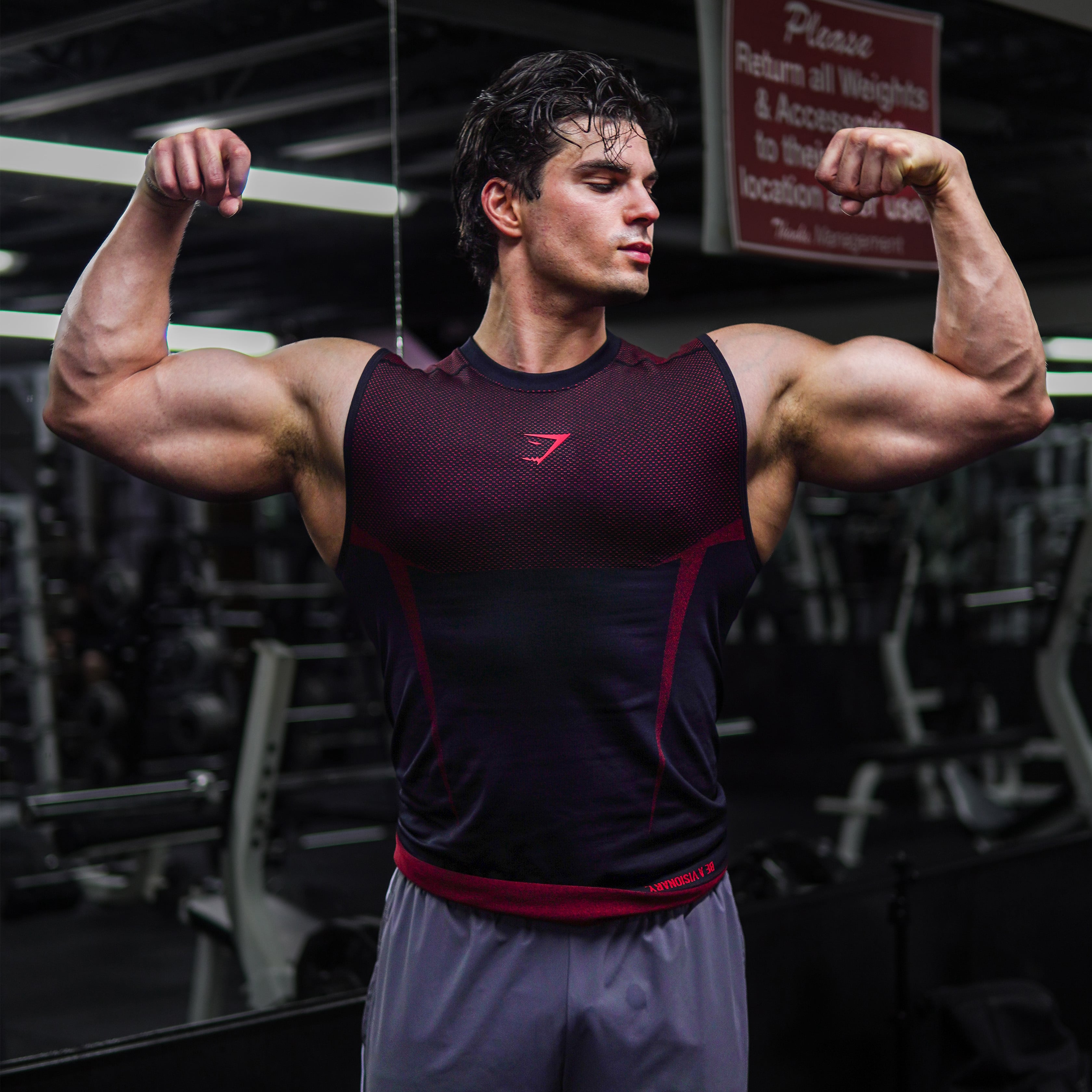
Let’s talk hypertrophy— it’s the term you’ve all probably used and heard in the gym while chatting about your goals and your PR’s, but there can be some confusion about its definition (especially when comparing it to strength training). So let’s make things simple, hypertrophy = the process of building muscle through resistance training. Whether you’re aiming for a pumped-up physique, stronger lifts, or a more defined frame that fits your favorite gym ‘fit just right, hypertrophy is your ticket there.
You can’t win with hypertrophy by just picking up heavy weights and putting them back down. Understanding how muscle growth works is the secret sauce to seeing progress that sticks and avoiding that dreaded plateau. Because if you’re spending hours in the gym but not seeing gains, it can feel like you’re stuck on a hamster wheel.
So to help us break down what hypertrophy really means–and share the methods proven to spark muscle growth–we’ve teamed up with Ryan Terry: 2x Men’s Physique Olympia champion and 3x Arnold Classic winner, known for his razor-sharp conditioning, trademark midsection, and balanced, aesthetic physique. As one of the UK’s most recognised bodybuilders, Ryan arguably knows the journey of hypertrophy better than anyone.
We’ll talk about the differences between hypertrophy and strength training, how to structure your workouts for muscle growth, and what training techniques will get you to your goals–with insights from Ryan along the way.
What Is Hypertrophy?
Hypertrophy is the process of muscle growth–when your muscles get bigger in response to training. It happens through a cycle of stress, damage, and repair: you lift weights (stress), which creates tiny tears in your muscle fibres (damage), and your body repairs and rebuilds them to be stronger and thicker than before (repair). Over time, this repeated cycle leads to visible muscle growth.
Essentially, that means that every time you train, your body goes through a chain reaction that triggers muscle growth–these are the three key drivers of muscular hypertrophy:
Mechanical tension - this is the force your muscles exert as they contract against resistance, aka the “load” or strain your muscles endure when they lift weights.
Muscle damage - Tiny tears to your muscle fibres (don’t panic, it's a good thing!) occur when your muscles get used and help you build mass.
Metabolic stress - That deep burn and pump you feel mid-set? That’s stress in action; it’s a factor that influences anabolism*, specifically muscle growth (hypertrophy).
All three work together to trigger the body’s muscle-building process, where new muscle proteins are synthesized, leading to increased muscle size and strength.
*In simple terms, anabolism is the mechanism that takes smaller units like nutrients, cells, or amino acids and bonds them together to create bigger structures, and in the context of hypertrophy, it refers to the process of building bigger muscle tissue, specifically the synthesis of new muscle proteins.
How to Train for Hypertrophy
So you’ve decided to give hypertrophy a go–but how do you train for it? Unfortunately, building muscle isn’t easy, and unless you’re relatively new to resistance training, and benefit from ‘newbie gains’ (yes, it’s a thing), then muscular hypertrophy does take time, hard work and commitment [4].
Luckily, we’ve refined the process and found a clear formula to maximise those gains:
Stick to rep ranges of 6 to 30 reps
Use 10-12 sets for session
Train each muscle 2 to 3 times a week
Progressively overload
Increase time under tension
Rest for 1 to 2.5 minutes between sets
Aim for 7–9 hours of quality sleep each night
Eat enough to fuel your body
How to Train for Hypertrophy
1. Stick To The Muscle-building Rep Range
What the research says 👉 It has long been agreed that 6 to 12 reps per set is the ideal muscle hypertrophy training range (as stated by the ACSM) [5]. More recently, research has challenged this, finding that the key to muscle growth is training close to failure rather than training within a specific rep range.
The 2021 study by Schoenfeld et al found that muscle growth can occur with light, moderate, or heavy loads in ranges from 6 to 30 reps, as long as sets were taken close to failure [6]. In fact, Ryan Terry currently varies his rep ranges from 6 reps right the way up to 18 reps during his 2025 Olympia prep.
✅ Stick to rep ranges of 6 to 30 reps, choosing a weight that is heavy enough to be tough (but not so heavy that you’re failing at rep three). You should finish each set feeling like you could do about two more reps, but no more! This range keeps muscles under tension just long enough to spark growth.
2. Do Enough Sets (But Not A Million)
What the research says 👉The ACSM states 3–6 sets per exercise to be a good range for muscle hypertrophy.
A study by researchers at Florida Atlantic University in 2025 found that more sets equaled more muscle growth gains–up to around 11 ‘fractional’ sets per session [7].**
✅ Train each muscle group with up to about 10–12 well-chosen sets per session, spread over 2 to 4 exercises.
**‘Fractional’ sets are a way of counting sets that recognises not all exercises hit a target muscle equally. They count direct sets (where the target muscle is the main mover) as 1, and indirect sets (where the target muscle helps, but isn’t the main mover) as 0.5.
3. Train Each Muscle A Couple Of Times A Week
What the research says 👉 Hitting each muscle group 2–3 times a week beats hammering it once, then ignoring it for the next six days.
This has been proven in various studies, including this 2016 review published in the Journal of Sports Medicine that pulled together data from 10 experimental trials comparing different training frequencies, which found that greater training frequency led to greater hypertrophy [8]. (That being said, the researchers couldn’t say whether three times per week is better than two, because there weren’t enough well-designed studies comparing those directly.)
So, how should you programme this throughout the week? Some studies found no significant differences between full-body and split routines (i.e., upper/lower split, push/pull/legs) when weekly volume was equated [9,10]. However, Bartolomei et al. found split routines might be superior for muscle growth in trained men who had at least 3 years of consistent resistance training experience and trained at least 3 times per week [11].
‘Whether you’re using a 3, 4, or 6 day a week plan, ensure every muscle part has enough time and attention spent on it,’ says Ryan.
✅ Aim to train target muscles at least twice a week, using a split routine or full body routine.
Find out more about the different workout splits and which is best for your goal.
4. Increase The Difficulty Over Time
What the research says 👉 Whether it’s an extra rep, a touch more weight, or an additional set, progressive overload is essential for continued progress, especially when it comes to muscular hypertrophy [12].
‘Form is important when performing an exercise, but equally as important as form is intensity. Make sure you really push yourself in the gym–the body is a lot more resilient than most people think.’ - Ryan Terry.
✅ Whether it’s recording your exercises on the Gymshark Training App, writing your weights down in your notes app, or going old school with a pen and notepad, record every workout so you can increase the difficulty gradually each week–whether that’s increasing the weight, sets, reps, slowing down the tempo or decreasing rest periods.
5. Increase Time Under Tension
What the research says 👉 One of the best ways to increase intensity? Slow down those reps: A 2012 clinical trial found that slower repetition tempos can lead to greater increases in muscle protein synthesis compared to faster tempos at the same relative intensity [13].
✅ Don’t rush through your sets. Control the weight, feel the ‘squeeze’ (mind-muscle connection), and lower it slowly. Consider adding pauses at the bottom of the eccentric (lowering) phase, or adding a slower tempo to the eccentric portion of your lifts. Pauses remove momentum and force the target muscle to work harder out of the bottom, while a controlled eccentric increases muscle tension, which is a key driver of muscular hypertrophy.
6. Take The Rest Between Sets (It Matters More Than You Think)
What the research says 👉 Research on rest periods for hypertrophy suggests that longer inter-set rest intervals (>60 seconds) may be more beneficial for muscle building compared to shorter rest periods.
Schoenfeld et al. found that 3-minute rest intervals led to greater increases in muscle strength and thickness compared to 1-minute intervals in resistance-trained men [14]. Similarly, Grgic et al. (2017) reported a possible advantage for longer rest intervals in trained individuals [15].
‘Rest times are important,’ explains Ryan. ‘I aim for around 60-90 seconds [rest between sets].’
✅ Take 1 to 2.5 minutes between sets so you can go again with decent weight.
7. Prioritise Sleep & Recovery
What the research says 👉 Rest days are crucial for muscle growth because they allow muscles to repair and rebuild after exercise-induced damage. General guidelines (e.g. ACSM) recommend at least 48 h between resistance sessions for the same muscle group to optimise recovery, however, other research suggests that as little as 24 hours recovery between sessions could be enough, and didn’t inhibit strength and muscle gains in healthy, recreationally active young men [16,17].
Sleep is equally important for hypertrophy, as this is when the body releases growth hormone and ramps up muscle protein synthesis [18].
‘Recovery and sleep are one of the most important factors when trying to grow muscle,’ explains Ryan. ‘You can train as hard as you want, [but] rest and recovery (sleep) is what repairs and essentially grows the muscle. One without the other is pointless. 7-9 hours sleep a night is a good amount for maximum recovery.’
✅ Aim for 7–9 hours of quality sleep each night, and pay attention to how your body feels when planning rest days. This is also why many lifters train different muscle groups on consecutive days–so each muscle still gets time to recover and grow, even if you’re in the gym daily.
8. Don’t Forget Nutrition
What the research says 👉 Nutrition plays a vital role in hypertrophy by supplying the protein and calories needed to repair and build bigger muscles after training. Eating enough–especially protein spread across the day–fuels recovery, supports muscle protein synthesis, and helps turn hard training into real gains [19,20]
‘When your main goal is to build muscle, food becomes fuel which is essential for muscle growth and repair,’ Ryan explains. ‘You need to ensure you are consuming the right food types such as bioavailable proteins, complex carbohydrates, and essential fats.’
✅ To build muscle without putting on too much fat, Ryan recommends:
Protein: 2 grams per KG of body weight
Carbs: 4-6g per KG of body weight (carbs are your main source of energy, so these are really important for fuelling your workouts)
Fats: 1g per KG of body weight (fats are also good for fuel, but you have to be careful as they are much higher in calories and can soon jump those daily calories up).
The Best Exercises for A Hypertrophy Workout
So you know how to train for muscle hypertrophy, but what exercises should you use in your hypertrophy workout?
To build a successful hypertrophy workout, you should include:
Compound Exercises (multi-joint exercises that engage large muscle groups)
AKA your big, multi-joint exercises. These should be programmed at the start of your hypertrophy workout.
A review published in the Journal of Strength & Conditioning Research found that when following progressive overload, compound exercises activate the three key components for muscle building: mechanical tension, muscle damage, and metabolic stress.
Lifting moderate to heavier loads during compound lifts means that more fast-twitch muscle fibers (type II) are recruited, which have the greatest potential for growth, making these exercises extremely important in hypertrophy training [21].
The top compound lifts for size:
Squats: Quads, glutes, hamstrings, core
Deadlifts: Glutes, hamstrings, back, traps
Bench press: Chest, triceps, shoulders
Pull-ups/chin-ups: Lats, biceps, upper back
Compound lifts mainly recruit fast-twitch muscle fibers
Isolation Exercises (focus on a single muscle group or joint)
AKA your single-joint, ‘accessory’ exercises to focus and refine certain muscle groups. Keep these for after your compound exercises. Research has shown that isolation movements may be more effective for targeted muscle growth, as demonstrated by a study showing greater elbow flexor hypertrophy with bicep curls compared to dumbbell rows [22].
After your compound lifts have heavily recruited fast-twitch fibres, isolation moves can help fatigue the twitch fibers (type I), often by using higher rep training. These muscles are more suited to building endurance, but are still important for overall balance and conditioning.
A 2021 randomized control trial in the Journal of Sports Science confirmed that exercise selection plays a role in regional hypertrophy [23]. Consider what muscle group you want to focus on when choosing your exercises, and consider using supersets (two exercises done back-to-back) or trisets (three exercises done one after the other, resting only at the end of all three) to structure your isolation movements.
Examples of isolation movements include:
Bicep curls for biceps
Lateral raises for shoulders
Leg extensions for quads
Cable flyes for chest
Calf raises for calves
The ACSM states exercises should be ordered by: Large muscle groups before small; Multi-joint before isolation; High-intensity before low-intensity.
‘Incorporating compound lifts is great for overall power, strength, and core stability, whilst isolation movements predominantly focus on one specific muscle at a time. Both are essential when trying to build and sculpt a physique.’ – Ryan Terry
Hypertrophy vs Strength: What’s The Difference?
Hypertrophy and strength training might both involve lifting weights, but they play by very different rules.
Hypertrophy training is focused on increasing muscle size (aesthetically). It involves lifting moderately heavy weights (dumbbells, barbells or kettlebells) for around 6 to 12 reps per set (typically 3-6), keeping rest periods fairly short (around 30 to 90 seconds), racking up a decent amount of volume across your workout using a mixture of compound and isolation movements and aiming for around 10 to up to 40 sets per muscle group a week (aka 19 sets for a pull workout). This style is common in bodybuilding and physique training, where the goal is all about aesthetics and building balanced, defined muscle.
Strength training, on the other hand, is about focusing on raw power and pushing yourself to failure with the heaviest weights you can lift. It usually involves heavier loads, fewer sets (3-5), fewer reps (typically 1 to 6), and longer rest periods (2 to 5 minutes) so you can fully recover between sets. You’ll see this method of resistance training used by powerlifters, Olympic lifters, and athletes who want to generate max force, fast.
TLDR; here’s a quick breakdown of the main differences:
Hypertrophy training uses moderate weights, moderate reps (6–12), shorter rest, and higher volume.
Strength training uses heavy weights, low reps (1–6), longer rest, and lower to moderate volume.
💡Want the best of both worlds? You can combine both styles.
For example, you might follow a periodized plan, where you rotate between strength vs hypertrophy training phases every few weeks (e.g. four weeks of each).
Or try undulating periodization, where your rep ranges shift throughout the week, for instance, one heavy strength day, one moderate hypertrophy day.
You can even blend both into a single session (concurrent training) by kicking things off with low-rep compound lifts to build strength, then finishing with high-rep accessory work to target size.
When you understand how each style works, you can train smarter and more intentionally, whether you’re chasing size, strength, or a bit of both.
Need help deciding on your workout split and creating a program? Read our guide to workout splits for every goal.
Example 4-Day Hypertrophy Split (Push Pull Legs Split)
Day 1: Chest, Shoulders, Triceps (Push)
Barbell Bench Press: 3 sets of 6-12 reps
Incline Dumbbell Press: 3 sets of 6-12 reps
Dumbbell Shoulder Press: 3 sets of 6-12 reps
Lateral Raises: 3 sets of 10-15 reps
Triceps Pushdowns: 3 sets of 10-15 reps
Overhead Triceps Extensions: 3 sets of 10-15 reps
Day 2: Back, Biceps, Forearms (Pull)
Barbell Rows: 3 sets of 6-12 reps
Lat Pulldowns: 3 sets of 8-12 reps
Seated Cable Rows: 3 sets of 8-12 reps
Bicep Curls: 3 sets of 8-12 reps
Hammer Curls: 3 sets of 10-15 reps
Wrist Curls: 3 sets of 12-15 reps
Day 3: Legs (Quads, Hamstrings, Glutes, Calves)
Barbell Squats: 3 sets of 6-12 reps
Leg Press: 3 sets of 10-15 reps
Leg Extensions: 3 sets of 12-15 reps
Romanian Deadlifts: 3 sets of 10-15 reps
Leg Curls: 3 sets of 12-15 reps
Standing Calf Raises: 3 sets of 15-20 reps
Day 4: Repeat Push or Pull Day
Choose exercises from Day 1 or Day 2, focusing on areas you want to prioritize or haven't hit as hard.
Ryan Terry’s 2025 Olympia Prep Training Split (Body Part / Bro Split)
Ryan Terry follows a 7-day split, training twice a day. It combines daily cardio and abdominal/core work in the mornings with focused resistance training sessions targeting one or two muscle groups each evening.
Ryan’s split shows what’s possible at the highest level–but that does not mean you need to train twice a day, everyday!
Even if you aspire to compete in bodybuilding, or just want to achieve a physique like Ryan’s, you’ll still make great progress with a 3, 4 or 5 day split, training each muscle group at least twice a week, balanced with enough recovery, good nutrition and consistency — without needing to live in the gym.
Ryan Terry’s Workout Split
Monday
AM Cardio/Stretch/Posing
PM Back and Biceps
Tuesday
AM Cardio/Abdominals
PM Chest and Triceps
Wednesday
AM Cardio/Abdominals
PM Legs
Thursday
AM Cardio/Abdominals
PM Shoulders
Friday
AM Cardio/Abdominals/Stretch
PM Back
Saturday
AM Cardio/Stretch /Posing
PM Arms
Sunday
AM Cardio/Stretch
PM Abdominals/calves
Train Smart, Stay Consistent, and Play the Long Game
If you want to look as strong outside the gym as you do inside, hypertrophy is what you need to pay attention to—that athletic physique that screams ‘yeh, I work out’.
Some are more genetically blessed with muscle-building abilities, but luckily, there are steps we can all take to maximize the likelihood of gains by training smart, fuelling our bodies right, and staying consistent even on those days when motivation hits snooze.
‘Fitness is a lifestyle and not a quick fix, so you have to be patient and play the long game,’–Ryan Terry.
Ryan suggests: ‘Set[ting] yourself short-term goals within an achievable timescale [as] stepping stones to your long-term goals. Breaking it down like this makes it more manageable and will keep you on track and motivated.’
Progress doesn’t come overnight, so be patient. Don’t just chase the pump, train to build, lift with intention, trust the process, and push to your limits.
FAQs
Is Hypertrophy The Same As Bodybuilding?
No–the two are related, but they’re not the same thing:
Bodybuilding is a sport and training style focused on developing muscle size, symmetry, and definition to create a visually impressive physique, often for competition or aesthetic goals. Think Ryan Terry or CBum, the aspiring Mr and Ms. Olympia’s of this world that use hypertrophy training as part of their prep.
Hypertrophy is the process and training goal of making muscles bigger–used by your average gym goer up to bodybuilders and athletes-alike. It’s a method of building muscle, not a sport by itself.
Do Genetics Play A Role In Hypertrophy?
Yes! While your training, nutrition, and recovery habits play a huge role in how much muscle you can build, genetics are a key factor too. As Schoenfeld highlights in Science and Development of Muscle Hypertrophy, some individuals are simply more predisposed to muscle growth based on their genetic makeup [1].
Things like muscle fibre type distribution, hormone levels, and recovery speed all affect your hypertrophy potential. That said, consistency still beats comparison, because even if progress is slower for some, it is still possible. Focus on training smart, eating well, and showing up regularly. Results don’t happen overnight; stay consistent and be patient.
Can You Still Build Strength With Hypertrophy?
Yes — but big muscles aren’t always an indicator of being truly ‘strong’.
Building larger muscles through hypertrophy training increases the muscle's potential to produce force. However, research–including a study published in Medicine & Science in Sports and Exercise–has shown that muscle size and strength are only weakly correlated [24].
Further findings, like those in the European Journal of Translational Myology, confirm there is a connection between muscle hypertrophy and strength, but the amount of strength you gain can vary. This depends on factors such as how well your nervous system adapts, learns to recruit muscle fibers efficiently, and coordinates movement [25].
Further findings, like those in the European Journal of Translational Myology, confirm there is a connection between hypertrophy and strength, but the amount of strength you gain can vary. This depends on factors such as how well your nervous system adapts, learns to recruit muscle fibers efficiently, and coordinates movement [25].
So, while hypertrophy training does increase strength, the strength gains might not be proportional to the increase in muscle size. To maximise strength, it helps to include heavier, lower-rep training that targets neural adaptations and makes your body better at activating your muscles.
Are Free Weights or Machines Better for Gaining Muscle?
There’s no one-size-fits-all answer here; both free weights and machines can build muscle effectively (hypertrophy) when used with proper form and progressive overload.
Free weights (like dumbbells, kettlebells, and barbells) recruit more stabilizing muscles, engage your core, and carry over well to real-life movements. They’re ideal for compound lifts and give you full control over your range of motion.
Machines, on the other hand, can help isolate specific muscles more precisely and often feel safer, especially for beginners or anyone rehabbing an injury. They also make it easier to train to failure without worrying about balance or form breaking down.
The best approach? Use both. Combine free weights for big compound lifts (e.g., squats, presses, deadlifts) with machines or cables for isolation work (e.g., leg extensions, kickbacks, lateral raises) to hit all angles and balanced muscle growth.
Can Beginners Build Muscle With Hypertrophy Training?
Yes, beginners can make serious gains building muscle with hypertrophy training, and often faster than more experienced lifters. This sweet spot is known as “newbie gains”, where your body responds quickly to training because it’s never been exposed to that kind of stimulus before.
Just keep in mind: beginners don’t need overly complicated programs or tons of volume. A simple full-body routine, hitting each muscle group 2–3 times per week with progressive overload, is more than enough to see visible results.
Focus on:
Mastering proper form
Staying consistent
Eating enough protein
Training close to failure (without ego lifting)
Start strong, and the gains will come fast.
Why Am I Getting Stronger but Not Bigger?
This one’s more common than you’d think. If you’re gaining strength but not size, it’s likely due to neural adaptations, meaning your nervous system is getting better at recruiting muscle fibres, which is making your lifts feel easier without necessarily adding mass.
Other possible reasons include:
Not eating enough (no calorie surplus = no building blocks)
Not training close enough to failure
Not doing enough volume (sets x reps x load)
Focusing more on strength-style rep ranges (1–5) than hypertrophy ranges (6–12+)
The solution? Dial in your nutrition, increase training volume, and ensure you're actually challenging the muscles- developing a strong mind-muscle connection can help with this one, and not just moving the weight from A to B.
References:
[1] Schoenfeld, B. (2016). Science Science AND AND Development Development OF OF Muscle Muscle Hypertrophy Hypertrophy Second Edition. [online] Available at: https://www.circuitoultras.org/wp-content/uploads/2021/05/Science-and-development-of-muscle-hypertrophy-by-Brad-Schoenfeld-z-lib.org_.pdf.
[2] Churchward‑Venne, T. A., Murphy, C. H., Longland, T. M., & Phillips, S. M. (2013). Role of protein and amino acids in promoting lean mass accretion with resistance exercise and attenuating lean mass loss during energy deficit in humans. Amino Acids, 45(2), 231–240. https://pubmed.ncbi.nlm.nih.gov/23645387/
[3] Figueiredo, V. C., Ca ldow, M. K., Massie, V., Markworth, J. F., Cameron-Smith, D., & Blazevich, A. J. (2019). The role of protein and amino acids in promoting resistance exercise–induced skeletal muscle hypertrophy. Frontiers in Nutrition, 6, 78. https://pubmed.ncbi.nlm.nih.gov/31508978/
[4] Lopez, P., Radaelli, R., Taaffe, D.R., Newton, R.U., Galvão, D.A., Trajano, G.S., Teodoro, J., Kraemer, W.J., Häkkinen, K. and Pinto, R.S. (2020). Resistance Training Load Effects on Muscle Hypertrophy and Strength Gain. Medicine & Science in Sports & Exercise. https://pmc.ncbi.nlm.nih.gov/articles/PMC8126497/
[5] American College of Sports Medicine (2009). Progression models in resistance training for healthy adults. Medicine & Science in Sports & Exercise, [online] 41(3), pp.687–708. https://pubmed.ncbi.nlm.nih.gov/19204579/
[6] Schoenfeld, B.J., Grgic, J., Van Every, D.W. and Plotkin, D.L. (2021). Loading Recommendations for Muscle Strength, Hypertrophy, and Local Endurance: a Re-Examination of the Repetition Continuum. Sports, 9(2), p.32. https://pmc.ncbi.nlm.nih.gov/articles/PMC7927075
[7] Remmert, J.F. (2025). View of Is There Too Much of a Good Thing? [online] Sportrxiv.org. Available at: https://sportrxiv.org/index.php/server/preprint/view/537/1148.
[8] Schoenfeld, B.J., Ogborn, D. and Krieger, J.W. (2016). Effects of Resistance Training Frequency on Measures of Muscle Hypertrophy: A Systematic Review and Meta-Analysis. Sports Medicine, [online] 46(11), pp.1689–1697. https://pubmed.ncbi.nlm.nih.gov/27102172/
[9] Evangelista, A.L., Braz, T.V., La Scala Teixeira, C.V., Rica, R.L., Alonso, A.C., Barbosa, W.A., Reis, V.M., Baker, J.S., Schoenfeld, B.J., Bocalini, D.S. and Greve, J.M.D. (2021). Split or full-body workout routine: which is best to increase muscle strength and hypertrophy? https://pubmed.ncbi.nlm.nih.gov/34468591/
[10] Lasevicius, T., Schoenfeld, B.J., Grgic, J., Laurentino, G., Tavares, L.D. and Tricoli, V. (2019). Similar Muscular Adaptations in Resistance Training Performed Two Versus Three Days Per Week. Journal of Human Kinetics, 68(1), pp.135–143. https://pmc.ncbi.nlm.nih.gov/articles/PMC6724585/
[11] Bartolomei, S., Nigro, F., Malagoli Lanzoni, I., Masina, F., Di Michele, R. and Hoffman, J.R. (2020). A Comparison Between Total Body and Split Routine Resistance Training Programs in Trained Men. Journal of Strength and Conditioning Research, 35(6), p.1. https://pubmed.ncbi.nlm.nih.gov/32168178/
[12] Geantă, V.A. (2021). Improving muscle size with Weider’s principle of progressive overload in non-performance athletes. [online] ResearchGate. https://www.researchgate.net/publication/358008997_Improving_muscle_size_with_Weider's_principle_of_progressive_overload_in_non-performance_athletes
[13] Burd, N.A., Andrews, R.J., West, D.W.D., Little, J.P., Cochran, A.J.R., Hector, A.J., Cashaback, J.G.A., Gibala, M.J., Potvin, J.R., Baker, S.K. and Phillips, S.M. (2012). Muscle time under tension during resistance exercise stimulates differential muscle protein sub-fractional synthetic responses in men. The Journal of Physiology, 590(2), pp.351–362. https://pubmed.ncbi.nlm.nih.gov/22106173/
[14] Schoenfeld, B.J., Pope, Z.K., Benik, F.M., Hester, G.M., Sellers, J., Nooner, J.L., Schnaiter, J.A., Bond-Williams, K.E., Carter, A.S., Ross, C.L., Just, B.L., Henselmans, M. and Krieger, J.W. (2016). Longer interset rest periods enhance muscle strength and hypertrophy in resistance-trained men. Journal of Strength and Conditioning Research, 30(7), pp.1805–1812. https://pubmed.ncbi.nlm.nih.gov/26605807/
[15] Grgic, J., Lazinica, B., Mikulic, P., Krieger, J.W. and Schoenfeld, B.J. (2017). The effects of short versus long inter-set rest intervals in resistance training on measures of muscle hypertrophy: A systematic review. European Journal of Sport Science, 17(8), pp.983–993. https://pubmed.ncbi.nlm.nih.gov/28641044/
[16] Garber, C.E., Blissmer, B., Deschenes, M.R., Franklin, B.A., Lamonte, M.J., Lee, I-Min., Nieman, D.C. and Swain, D.P. (2011). Quantity and Quality of Exercise for Developing and Maintaining Cardiorespiratory, Musculoskeletal, and Neuromotor Fitness in Apparently Healthy Adults. Medicine & Science in Sports & Exercise, [online] 43(7), pp.1334–1359. https://journals.lww.com/acsm-msse/fulltext/2011/07000/quantity_and_quality_of_exercise_for_developing.26.aspx
[17] Yang, Y., Bay, P.B., Wang, Y.R., Huang, J., Teo, H.W.J. and Goh, J. (2018). Effects of Consecutive Versus Non-consecutive Days of Resistance Training on Strength, Body Composition, and Red Blood Cells. Frontiers in Physiology, [online] 9(725). https://www.frontiersin.org/journals/physiology/articles/10.3389/fphys.2018.00725/full
[18] Åkerstedt, T., Nilsson, P.M. and Kecklund, G. (2009). Sleep and recovery. Current Perspectives on Job-Stress Recovery, 7, pp.205–247. https://www.semanticscholar.org/paper/Sleep-and-recovery-Åkerstedt-Nilsson/19473849bf79211c6c4b226e807f9ff11a73bc15
[19] Mayalata (2025). Impact of Exercise And Nutrition on Skeletal Muscle Growth: A Review. International Journal For Multidisciplinary Research, 7(1). https://www.semanticscholar.org/paper/Impact-of-Exercise-And-Nutrition-on-Skeletal-Muscle-Mayalata/59e08dffd76d92bf7b6b8c58dbec806d761cdfd6
[20] Paoli, A., Cerullo, G., Bianco, A., Neri, M., Gennaro, F., Charrier, D. and Moro, T. (2024). Not Only Protein: Dietary Supplements to Optimize the Skeletal Muscle Growth Response to Resistance Training: The Current State of Knowledge. Journal of Human Kinetics, [online] 91(Spec Issue), pp.225–244. https://www.semanticscholar.org/paper/Not-Only-Protein%3A-Dietary-Supplements-to-Optimize-Paoli-Cerullo/9d4b6abf02957b0ff7f773bf8375526bd48431c5
[21] Ogborn, D. and Schoenfeld, B.J. (2014). The Role of Fiber Types in Muscle Hypertrophy. Strength and Conditioning Journal, [online] 36(2), pp.20–25. https://journals.lww.com/nsca-scj/fulltext/2014/04000/the_role_of_fiber_types_in_muscle_hypertrophy_.3.aspx
[22] Mannarino, P., Matta, T., Lima, J., Simão, R. and Freitas de Salles, B. (2019). Single-Joint Exercise Results in Higher Hypertrophy of Elbow Flexors Than Multijoint Exercise. Journal of Strength and Conditioning Research, 35(10). https://pubmed.ncbi.nlm.nih.gov/31268995/
[23] Zabaleta-Korta, A., Fernández-Peña, E., Torres-Unda, J., Garbisu-Hualde, A. and Santos-Concejero, J. (2021). The role of exercise selection in regional Muscle Hypertrophy: A randomized controlled trial. Journal of Sports Sciences, 39(20), pp.2298–2304. https://pubmed.ncbi.nlm.nih.gov/34743671/
[24] Balshaw, T.G., Maden-Wilkinson, T.M., Massey, G.J. and Folland, J.P. (2021). The Human Muscle Size and Strength Relationship. Medicine & Science in Sports & Exercise, Publish Ahead of Print. https://journals.lww.com/acsm-msse/fulltext/2021/10000/the_human_muscle_size_and_strength_relationship_.13.aspx
[25] Reggiani, C. and Schiaffino, S. (2020). Muscle hypertrophy and muscle strength: dependent or independent variables? A provocative review. European Journal of Translational Myology, [online] 30(3). https://pmc.ncbi.nlm.nih.gov/articles/PMC7582410/#sec1-4