















When creating a well-rounded leg training program, it's crucial to focus on both the posterior and anterior chains. Regardless of your gender, there’s no denying that hip thrusts are one of the most effective exercises for engaging lower body muscles–particularly the glutes.
Maybe you’re keen to try them but think the setup looks daunting.
Maybe you’ve tried hip thrusts but stopped because you felt them in your lower back.
Maybe you’ve dismissed them for being ‘just for the girls chasing booty gains.’
This is where things are going to change. We’re going to take you through step-by-step instructions on how to set up hip thrusts (so you practically look like a pro next time you step into the weight section). We’ll show you how to stop any lower back involvement and prove that there are many reasons you should be doing hip thrusts–no matter your gender.
Get ready for a rundown of everything hip thrusts (and some variations to try, too).
What Are Hip Thrusts?
Hip thrusts are a powerful muscle-building and strength-training exercise primarily targeting the lower body's posterior (rear chain) muscles. Most notably, they engage the gluteus maximus (or, as you may know it, the glutes), the largest muscle in the buttocks.
How To Do Hip Thrusts With Good Form
To perform hip thrusts correctly - with good form- you'll need the following pieces of equipment:
A bench or well-built surface for the upper back to rest on.
A barbell, dumbbell, or another form of resistance, i.e., smith machine or resistance band.
A bar pad (to prevent the bar from digging into your hips).
In need of a barbell pad? Find out how to choose the best one for your hip thrust workout.
How To Do A Hip Thrust:
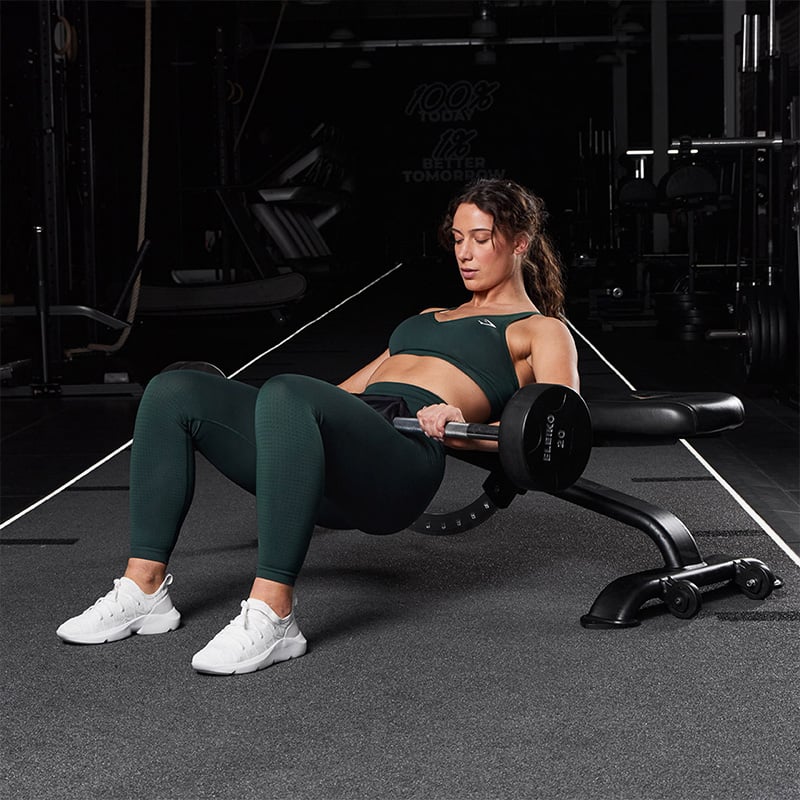
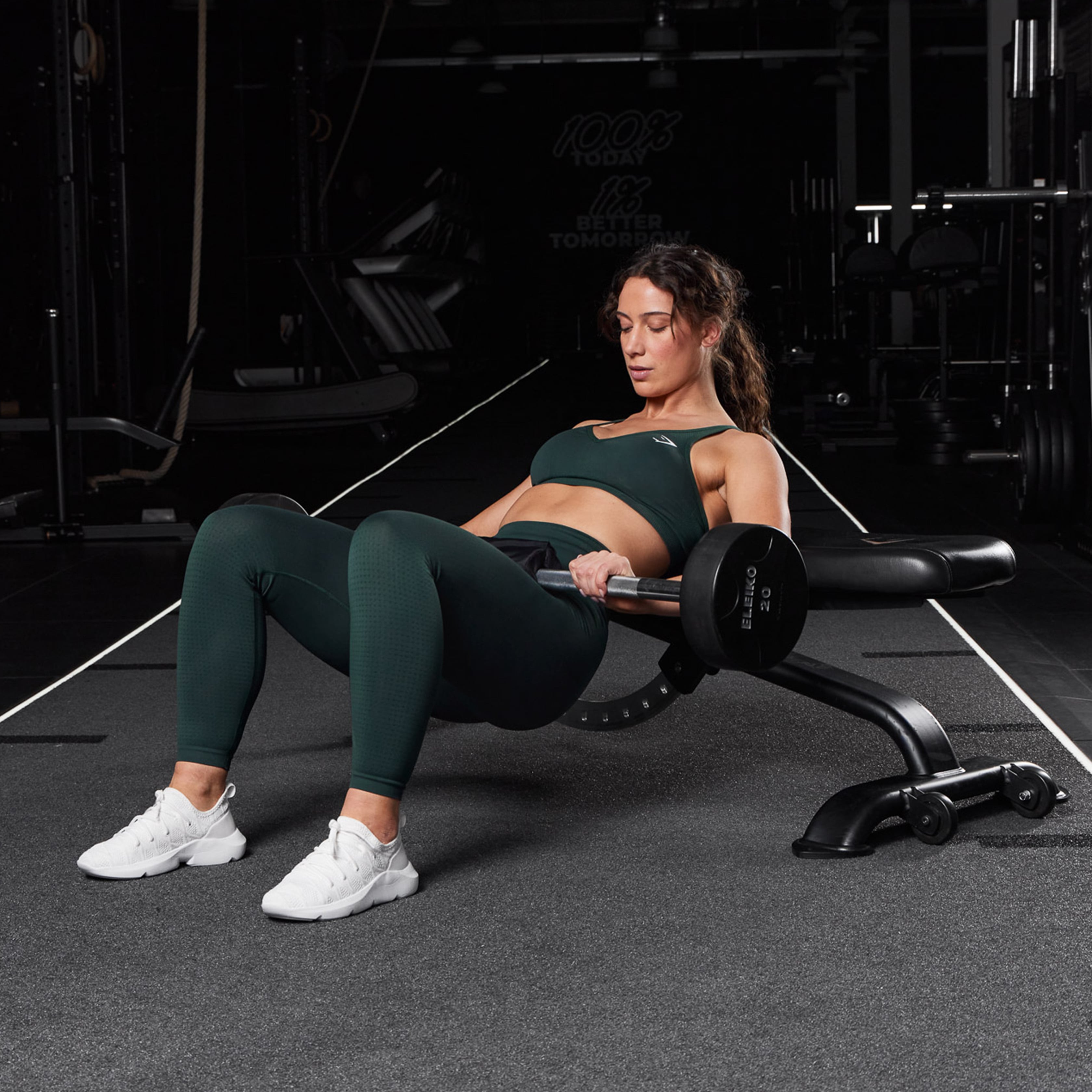
Keep the bench in its horizontal setting, ensuring it rests against a solid surface (like a wall) so it won't move. Sit on the floor, resting your upper back against the side of the bench, and place your feet flat on the ground, between hip-width and shoulder-width apart, at a 90-degree angle
Place the barbell (or dumbbell if using) over your hips.
Brace your core, keep your head neutral and chin slightly tucked with your hands resting on the barbell.
Push the floor away by driving through your heels and extending your hips towards the ceiling. Squeeze your glutes at the top of the contraction without overextending the lower back.
Lower your hips, return your bum to the floor in a controlled manner, and keep your upper back against the bench throughout.
How Many Reps Of Hip Thrusts Should I Do?
The number of repetitions depends on your overall fitness goal:
For Increased Lower Body Strength: if you aim to increase lower body strength, a rep range of up to 5 reps per set will work well [1].
For Muscle Mass: it's recommended that those focusing on hypertrophy (building muscle) stick to the 8-12 rep range.
Remember: Always begin with a relatively light load and ensure you master the fundamental form of the exercise before progressively increasing the weight - this will help minimise the risk of injury.
Feet Positioning: How To Get The Most Effective Glute Workout From Your Hip Thrusts
Proper hip thrust form is paramount, and the ideal foot positioning may vary depending on your lever length and anatomy. There isn’t a one-size-fits-all approach to hip thrusts, so you’ll have to play around with what feels best for you. If you feel hip thrusts in your lower back, it may be because your feet are in the wrong place.
A good starting point is to place your feet flat on the ground at shoulder width, with a slight flare of your toes for enhanced stability. It's essential to ensure that your knees track over your feet throughout the movement to avoid unnecessary joint strain.
Cues:
Glute Focused: if you're feeling most of the muscle activation in your quads and you'd like to share more of the load to your hamstrings (targeting your glutes harder), place your feet slightly further away from you and exaggerate, pointing your toes outward. Focus on driving through your heels and ensure you fully extend your hips at the top of the movement.
Quad-focused: If your hamstrings are taking most of the load and you'd prefer more quad activation, try placing the feet closer together and pointing the toes forward. Focus on driving through the balls of your feet.
Which Muscles Do Hip Thrusts Work?
Glutes
As mentioned previously, the hip thrust targets the glute muscles. As the primary driver of hip extension in the lower body, the glutes are responsible for thrusting the hips upward during the exercise.
The glutes contain three main muscles:
Glute Maximus: makes up the bulk of the buttocks and is essentially the main driving force of the glutes.
Glute Medius: This muscle sits above and to the sides of the glute maximus. It helps with hip abduction (taking the limbs away from the body's center line) and maintains balance.
Glute Minimus (the smallest of the three) helps with hip stabilisation and abduction.
The hip thrust is a compound exercise that targets the entire glute system, making it the GOAT of all glute exercises.
Looking for more glute max exercises to build your glutes? Try these Best Lower Glute Exercises.
Hamstrings
The muscles on the posterior chain of the legs assist the glutes in hip extension when performing the concentric contraction (pushing the bar upwards).
The hamstrings are made up of three muscles. These are the Biceps Femoris (which has a long and a short head, like the biceps in your arms), the Semimembranosus, and the Semitendinosus. The hamstrings are responsible for knee flexion (bending the knee), hip extension (moving the leg backwards), stabilisation, and posture support.
Not only do barbell hip thrusts cause greater activation of the glutes than barbell back squats, but they also have a higher impact on the hamstrings. So, if you’ve been squatting and wondering why your hamstrings aren’t growing, hip thrusts may be your answer!
Erector Spine
During exercise, protecting the spine, particularly the lower back, is key to building a strong body and preventing injury. The erector spinae muscles help to stabilise the lower back during the hip thrust; they are engaged to maintain a straight back and protect the spine. Appropriate hip thrust form is paramount because the exercise places the erector spinae vulnerable.
Each muscle runs up the back along each side of the spine, providing support. It is also responsible for tension, rotation, and upright posture.
Adductors
Adductors are the muscles on the inside of the thigh. Adduction is the process of bringing legs or limbs closer to the midline of the body. The primary function of the adductors during the hip thrust is to maintain stabilisation and assist with hip flexion.
Hip Thrust Benefits
Incorporating hip thrusts into your leg day routine offers a range of benefits. We spoke to Lifting Club Manager, Samantha Cubbins, to get the lowdown on all the hip thrust good stuff:
Building Bigger Glutes: Hip thrusts allow you to maintain high levels of tension through the glutes as you move through hip extension, making them a useful exercise for building glute strength.
Lower Back Support: Strengthening the erector spinae muscles can reduce the risk of injuries.
Enhanced Performance: Improved lower body strength through hip thrusts can translate into other movements, including squats, deadlifts, and even sprinting.
She also explains that:
“Hip thrusts directly target the glutes, with assistance from the hamstrings and adductors. They can be loaded progressively and help develop powerful hip extension, which can also support exercises such as the deadlift.”
Common Hip Thrust Mistakes
According to Sam, the most common hip thrust mistakes to avoid are:
Bouncing through your reps: Instead, control both the lifting and lowering phases rather than bouncing the bar at the top or bottom.
Using too much weight: If the load prevents you from reaching the top of the movement with control, reduce the weight and prioritise technique and full hip extension.
Poor foot positioning: Placing your feet too far forwards can increase hamstring involvement, not ideal if you're trying to emphasise the glutes.
Losing core engagement: Rib flare, failing to brace the abdominal wall, and curving the spine during a hip thrust reduce glute activation and shift unwanted stress to your lower back.
Hyperextending the spine at the top: Finish the rep by extending your hips and contracting your glutes rather than excessively arching your lower back and adding unnecessary strain.
“My key cues are to control the movement, drive your feet through the floor and pause at the top. Keep your chin tucked or look towards your belly button rather than throwing your head back.” - Samantha Cubbins
Are There Any Hip Thrust Variations?
Hip thrusts have many variations, from single-leg hip thrusts to b-stance hip thrusts.
The general movement of a hip thrust can be completed using various resistance-based equipment (barbells, dumbbells, machines, resistance bands, body weight), making it one of the best glute exercises for building muscle, size, and strength.
Hip Thrust Variations:
Single Leg Hip Thrusts
A fantastic variation of the standard barbell hip thrust is a single-leg hip thrust, performed with either a barbell or dumbbell resting on your hips while one leg is raised off the ground.
Training muscle groups unilaterally helps address imbalances in strength or body composition and can be a valuable addition to your workouts.
B-Stance Hip Thrusts
The b-stance hip thrust is akin to the single-leg hip thrust but allows for increased resistance with a barbell. The "b-stance" refers to an adjustment in foot positioning—instead of planting both feet equally or raising one, the heel of one foot aligns with the toes of the other.
This arrangement balances the load between the working leg and the one posted on the opposite heel for stability.
Resistance Banded Glute Bridges
The resistance band glute bridge is a great option for an easy glute-building home workout. This exercise requires you to loop a resistance band above your knees. To increase glute activity, maintain a slight press outward with your knees while performing the hip thrust.
Hip Thrust Alternatives
If hip thrusts cause you discomfort, but you still want to build bigger, stronger glutes, there are a few alternatives that you can explore during your next leg day workout.
Glute Bridges
As the lower back can hurt for some people when performing barbell hip thrusts, glute bridges are another great option. This exercise uses hip extension while the back is lying on the floor. Simply place your feet and legs in the same position as you would for a hip thrust whilst lying on your back, and then extend your hips towards the ceiling, pushing through your heels.
This exercise is best performed with no resistance and higher repetitions, as holding a weight can be awkward and uncomfortable in this position. Glute bridge vs. hip thrust benefits include less stress on the lower back and no need for equipment.
Kas Glute Bridge
A FitTok favourite that isolates your glutes to the maximum. If you’re looking for another exercise to help you fill your scrunch butt shorts, the kas glute bridge is the one.
The setup of the kas glute bridge is exactly the same as hip thrusts–but with this exercise, you’ll use a shorter range of motion, performing just the top half of the hip thrust. By not coming all the way down to the ground, you’ll keep the tension in the glutes throughout the exercise, meaning you’ll really feel your glutes burn!
You shouldn’t feel these in your quads, but check your foot position if you do. Your feet must be far enough away from the bench so that the knees bend at a 90-degree angle. Have them too close, and your quads will start working.
Make sure your feet are shoulder-width apart, with your toes externally rotated outwards slightly. When you thrust your hips up, fully extend your hips, squeezing your glutes as you do so.
Whether you’re new to working out or are an experienced lifter, the hip thrust should have a place in everyone's training routine. Undoubtedly one of the best exercises for glute development and a great movement which could help keep injuries at bay.
How To Progress Your Barbell Hip Thrust
Once you've mastered your hip thrust technique, progressive overload can help you continue building strength.
However, increasing the weight isn't your only option; as Sam explains, another way to progress is to slow the movement down to increase time under tension.
You can also:
Increase reps: Add more reps while maintaining good technique.
Increase your sets: Add an extra set to increase overall training volume.
Add a pause: Hold and squeeze your glutes at the top of each rep.
Try single-leg variations: Progress to single-leg hip thrusts to increase the demand on each glute individually and challenge stability.
Leg day on the cards? Make sure you have the best activewear that won't hold you back.
FAQs
How Long Does It Take To See Results From Hip Thrusts?
There is no set time frame for how quickly results are seen, but it could take anywhere from 4 to 12 weeks to see results.
A 2017 study measuring the effect of dumbbell curls and shoulder presses on untrained men found that muscle growth could noticed after only 4 weeks [2]; however, it could take up to 18 sessions to see significant hypertrophy (as found by this 2018 study [3]).
A 2018 review concluded that it often takes 8 to 12 weeks to see noticeable results in strength gains (however, results can be seen quicker, particularly if you are new to strength training) [4].
Be consistent with your training, eat enough protein to elicit muscle growth, and respect your recovery between sessions–all these factors will contribute to how quickly you see results.
How Often Should I Do Hip Thrusts
Do hip thrusts once or twice a week for optimum glute growth.
It is well-regarded that the optimum training frequency for muscle growth is two times a week [5]. New research in 2024 expanded on this, finding that the most effective range for muscle growth is 5-10 sets per week per muscle group, with four sets per week being the absolute minimum.
If you want to grow your glutes, aim to perform 5-10 sets per week of glute exercises–this might be hip thrusts or any of the hip thrust variations above. Need more ideas? Check out our best glute exercises.
What Is A Good Weight To Hip Thrust?
This will be relative to your training experience, weight and gender, however, you should always aim for a weight that is challenging but that still allows you to maintain proper form throughout the reps.
Your last rep should be just as good as your first rep. If it’s not, you should reduce the weight so you can perform each rep to the same standard.
If you’re new to hip thrusts, start by using a light weight to get a feel for the movement. You could even use your bodyweight or a single dumbbell when you are just starting out before progressing to using the barbell.
Why Do I Feel Hip Thrusts In My Lower Back?
This could be a due to a number of reasons but is most likely down to your form, for example:
Incorrect foot placement (i.e. feet too far or too close to the bench. Aim to make a 90 degree angle at your knees when your hips are extended)
Overextending your back at the top of the movement
Not engaging your core properly
Lower back pain during hip thrusts could also be down to lifting too heavy or weakness in your glutes, meaning that the lower back recruits to take some of the load off the hips.
If you do experience lower back pain during hip thrusts, stop immediately, check your form, and reduce the weight you are using.
Which Is Better For Glute Growth, Hip Thrust Or Glute Bridge?
Hip thrusts are usually considered better for glute growth, as they use a greater range of motion and allow you to load a heavy weight using a barbell.
Glute bridges are, however, sometimes a better option, for example, if you’re a beginner. As a bodyweight exercise, glute bridges are easy to get the hang of, making them very accessible. They are also a great at-home glute exercise, requiring no equipment but with the option to add a mini resistance band above the knees or even a dumbbell to make them more challenging. However, they are unlikely to produce hypertrophy to the same extent as hip thrusts due to more limited loading options.
Are Hip Thrusts Better Than Squats?
This depends on your goal, but hip thrusts are just as good (if not better) than squats for glute growth!
This is supported by a 2023 study that examined muscle activation in a group of untrained men and women who completed either hip thrusts or squats for nine weeks. The study found that both exercises produced similar glute growth. However, hip thrusts activated the glutes slightly more, while squats were slightly more effective in activating the quads and adductors.
However, it’s worth noting that squats are a far more holistic exercise, engaging multiple muscles throughout the body. For overall strength, improved athletic performance and injury prevention, squats would be the preferred exercise.
References:
Schoenfeld, B.J., Grgic, J., Van Every, D.W. and Plotkin, D.L. (2021). Loading Recommendations for Muscle Strength, Hypertrophy, and Local Endurance: a Re-Examination of the Repetition Continuum.
Stock, M.S., Mota, J.A., DeFranco, R.N., Grue, K.A., Jacobo, A.U., Chung, E., Moon, J.R., DeFreitas, J.M. and Beck, T.W. (2017). The time course of short-term hypertrophy in the absence of eccentric muscle damage.
Damas, F., Libardi, C.A. and Ugrinowitsch, C. (2017). The development of skeletal muscle hypertrophy through resistance training: the role of muscle damage and muscle protein synthesis.
Hughes, D.C., Ellefsen, S. and Baar, K. (2018). Adaptations to endurance and strength training.
Schoenfeld, B.J., Ogborn, D. and Krieger, J.W. (2016). Effects of Resistance Training Frequency on Measures of Muscle Hypertrophy: A Systematic Review and Meta-Analysis.
Plotkin, D.L., Rodas, M.A., Vigotsky, A., et al (2023). Hip thrust and back squat training elicit similar gluteus muscle hypertrophy and transfer similarly to the deadlift.