















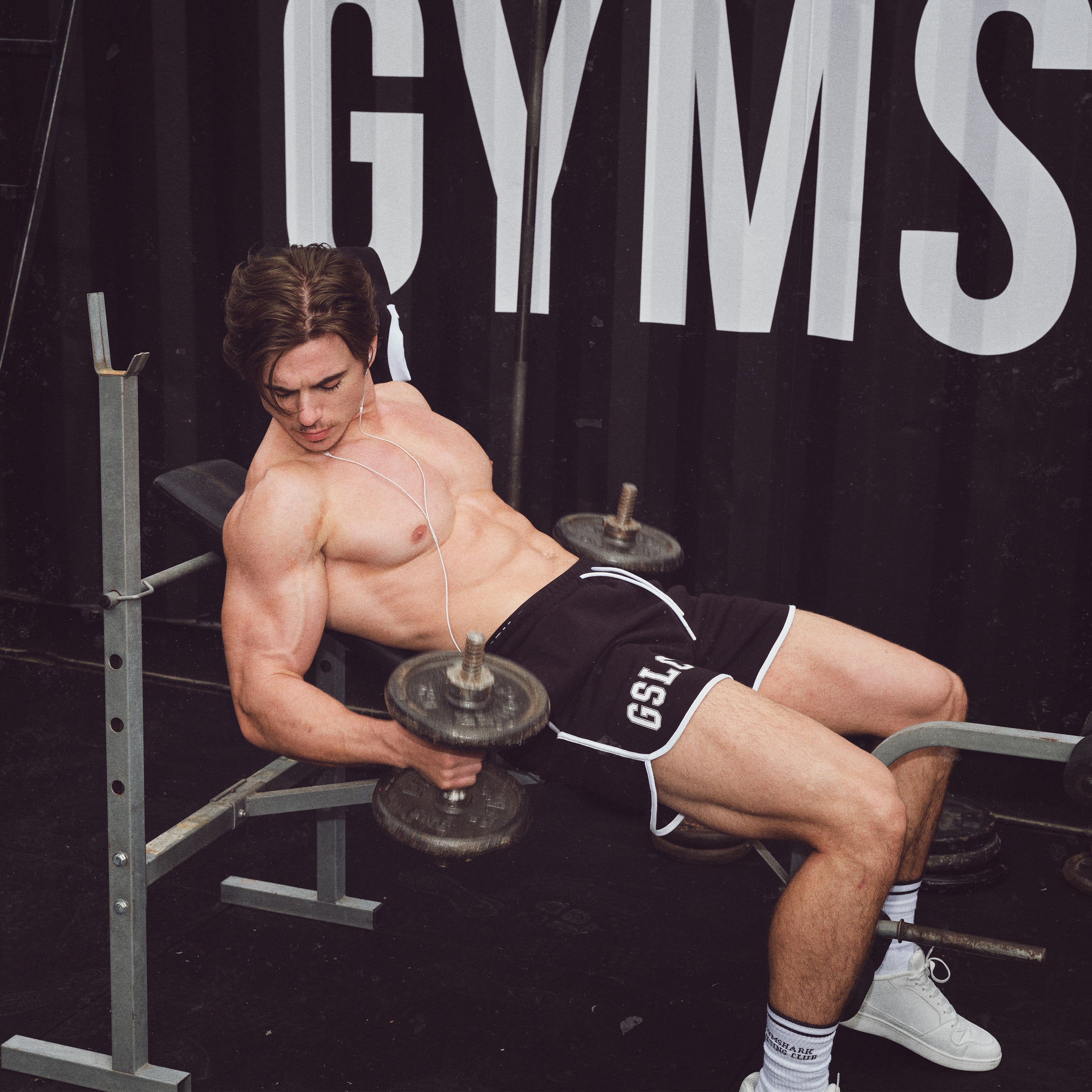
It’s easy to fall into the trap of doing bench press after bench press on repeat and think that that’s enough to grow your chest. But if there’s one thing we know, the likes of CBum did not get his chest from the classic bench press alone.
That’s right–If you’ve mastered the sculpted, sharp lower pec line and want to start building some serious pec shape and size, it’s time to sprinkle some upper chest exercises into the mix.
We’re talking incline press, flyes, and decline press-ups: Exercises that hit the upper chest area around your collarbone to make the chest look square and lifted (rather than drooping or “bottom-heavy”–which no one wants).
Developing the upper chest is what gives your chest size when viewed from the side;
Makes it look lifted when wearing your sports bra;
And enhances that v-taper upper body shape when you pop on your muscle fit tee.
But so many of us simply aren’t doing the upper chest-focused exercises to get us there!
Aesthetics aside, upper chest workouts will improve your posture, support shoulder health, reduce the risk of muscle imbalances in the chest, and benefit sports that involve throwing, tackling, rebounding, or climbing.
All this can be yours, with just a few exercises: And we’re going to show you how to do the six best upper chest exercises, to elevate your workout and your chest gains.
@jasonsphysique Upper chest focus 🤝🏽 #chestday #workout #gymtok #fyp full fit @Gymshark ♬ original sound - J A S O N S P H Y S I Q U E
The Best Upper Exercises
The best upper chest exercises combine dumbbell, barbell, and bodyweight exercises. From flyes to presses, these exercises target the upper chest muscles from different angles, helping you achieve fuller, more balanced development.
While barbells allow you to lift heavier, dumbbells challenge each side of the chest separately and demand more joint control; cables or landmine presses add constant tension and unique movement arcs. Not forgetting bodyweight movements too – ideal for an upper chest day at home, or a high rep finisher.
Picking a couple of these exercises for your upper body workout (and then doing a variation of different upper chest exercises later in the week) will ensure an effective, well-rounded upper chest workout.
1. Dumbbell Incline Bench Press
The incline bench press is the first upper chest exercise that will crop up in almost every upper chest workout. Along with the upper pecs, this exercise also engages the anterior delts (front shoulders) and triceps.
A 2010 study of 15 males found that the clavicular head of the pectoralis major (upper chest) showed greater activation at incline angles of 44° and 56°, while the sternocostal head (in the middle and lower region of the chest) was more active at a lat bench angle [1].
If possible, we recommend doing this exercise with dumbbells rather than a barbell. Dumbbells allow for a greater range of motion, and your elbows and wrists can move naturally, providing a deeper stretch at the bottom and a better contraction at the top. As each arm works independently, the dumbbell incline bench press can also help correct muscle imbalances that can happen with a barbell.
(However, it can also be beneficial to include some barbell bench press in your training, allowing you to lift heavier maximal loads to build strength.)
How To Do Dumbbell Incline Bench Press:
Set the bench to a 30–45° incline and hold a pair of dumbbells in neutral grip, resting the head on your thighs. Ensure your feet are flat on the floor, adding a plate under them if necessary.
Lean back onto the bench while
kicking
the dumbbells up to shoulder height, so that wrists, elbows, and shoulders are stacked in line. Hold the dumbbells with a neutral or pronated grip (palms facing forward). Plant your feet firmly on the floor, pull your shoulder blades together, and keep your chest lifted.
Slowly lower the dumbbells in a controlled manner until your elbows are at or slightly below chest level. Keep elbows at about 45° from your body, not flared wide or tucked too close.
Then, reverse the movement, pushing the dumbbells upward in a slight arc so they finish roughly above your collarbone. Squeeze your chest at the top, but don’t bang the dumbbells together.
Repeat and Maintain Form, ensuring your shoulders stay back and down and your elbows do not flare excessively. When finished, bring the dumbbells back to your thighs before sitting up.
2. Reverse Grip Bench Press
The OG of chest exercises–with a twist. The reverse grip bench press involves holding the barbell with an underhand (supinated) grip–palms facing towards you. It’s less common, but it’s an effective way to fire up the upper chest. A study in the Journal of Strength & Conditioning Research supports this, finding that a reverse grip during bench press increased activity in the biceps brachii and clavicular area of the pectoralis major [5].
If you don’t have access to an incline bench, this can be a great alternative to ensure you still fire up those upper chest muscles. Some also find this position more comfortable on the shoulders, placing less strain on the front delts due to the elbows staying more tucked toward your torso than the traditional bench press.
How To Do The Reverse Grip Bench Press:
Lie on a flat bench and grab the bar with an underhand (supinated) grip, hands just wider than shoulder width.
Pull your shoulder blades together, lift your chest, and plant your feet firmly.
Unrack the bar carefully (use a spotter) and hold it above your lower chest, elbows tucked in.
Lower the bar slowly toward your lower chest or upper stomach, keeping your elbows close to your body.
Press the bar back up in a slight arc until it finishes above your upper chest, then repeat.
3. Incline Dumbbell Squeeze Press
Another incline exercise that you’ll definitely feel in your upper chest. With the bench set at a 30–45° incline, this exercise involves pressing two dumbbells together throughout the movement, maximizing tension on the clavicular head.
Incline bench angle + conscious pressing together of the dumbbells = maximum upper chest recruitment.
Plus, it’s the ideal opportunity to focus on mind-muscle connection, leading to greater upper chest hypertrophy during your upper chest workout with dumbbells [6].
How To Do The Incline Dumbbell Squeeze Press:
Set the bench to a 30–45° incline and pick up a dumbbell in each hand.
Lie back on the bench, holding the dumbbells together with your palms facing each other, pressing them firmly.
Keep your shoulder blades retracted and your chest lifted throughout the movement.
Lower the dumbbells slowly toward your upper chest while maintaining the squeeze between them.
Press the dumbbells back up, continuing to squeeze them together, until your arms are nearly extended, then repeat.
4. Low To High Cable Fly
The low-to-high Cable Fly is an isolation exercise performed using a cable machine. In this exercise, you pull the cables upward in an arc from hip level toward shoulder or eye level.
This upward motion specifically targets the upper chest (clavicular head of the pectoralis major), and a study by Schütz et al. (2022) found that cable pulley exercises produce larger shoulder joint moments than bench press movements. Greater movement at the shoulder joint means the upper chest stretches more at the bottom and contracts harder at the top. This increased ROM means the clavicular fibers have to work harder to control and move the arm, increasing their mechanical tension, which is a key driver of muscle growth [7].
In addition, multiple studies comparing cable exercises, such as the chest press and bicep curl, have found greater muscle activation compared to machine-based variations [8,9]. With a greater range of motion (allowing for more natural movement) and constant tension from bottom to top, cable exercises such as low-to-high cable flies have the potential for greater muscle tension and, therefore, greater hypertrophy.
How To Do Low To High Cable Flies:
Set the cables to the lowest position and grab a handle in each hand with palms facing forward.
Step forward slightly, keeping a staggered stance and a slight bend in your elbows.
Lean forward a little, lift your chest, and retract your shoulder blades.
Pull the cables upward and inward in an arc until your hands meet around chest level.
Squeeze your upper chest at the top, then lower the cables back to the start under control.
5. Landmine Press
The barbell landmine probably isn’t something you use often in your training. Still, it’s an extremely useful piece of equipment that unlocks a range of unique pressing and pulling angles you can’t easily train with barbells or dumbbells. The upward, diagonal pressing path aligns well with the fibres of the clavicular head, making it great for adding size and shape to the upper chest. The fixed arch of the landmine press also makes it easier on the shoulder joint than overhead presses, making it more comfortable for those with past injuries or shoulder mobility issues.
The ‘landmine’ itself is just a floor-mounted hinge, but slip the bar into it and it’s given a new, faster way of moving. Most gyms have one (and it’s easy to set up), but otherwise, you can make your own landmine attachment by:
Wrapping a towel around one end of the barbell and wedge it securely into a corner, where the floor meets the wall;
Lying a heavy, rubber-coated weight plate (e.g., 25 kg / 45 lb) on the floor, slide one end of the barbell into the hole so it rests at an angle, using the inner rim of the plate as a pivot.
How To Do The Landmine Press:
Place one end of a barbell into a landmine attachment (or, use one of the DIY options above–just make sure you practice with an empty bar first to check it’s secure!).
Stand, half-kneel, or kneel on both knees facing the bar, and hold the free end with one hand at chest height.
Brace your core, lift your chest, and tuck your elbow toward your body.
Press the bar upward and slightly forward until your arm is nearly extended.
Lower back to the starting position with control, then repeat for reps.
6. Decline Push Ups
This bodyweight chest exercise is an excellent addition to any upper chest workouts at home, or to add more volume through your chest muscles using higher rep training as a finisher. Elevating your feet, using a bench, box, or even a couch, shifts the load towards the upper chest and front shoulders [10]. This mimics the pressing path of an incline bench press, helping build upper chest strength and definition without equipment.
One thing to note is that decline press ups are difficult: Elevating your feet shifts a greater percentage of your bodyweight onto your hands, increasing the load your chest, shoulders, and triceps have to push. To make this exercise easier, try lowering the height of your step, box, or bench, or do the decline press-up with your knees on the bench instead of your feet to take off some load.
To make these more difficult, place a weight plate on your back, or loop a long resistance band around your back and secure it under your palms as you perform the decline press up.
How To Do Decline Push Ups:
Set your feet on a stable elevated surface (bench or box) and place your hands on the floor slightly wider than shoulder-width, directly under your shoulders.
Engage your core and keep your body straight from head to heels — squeezing your glutes to avoid your hips sagging or hiking up.
Maintain a slight bend in your elbows and keep them tucked at about a 45-degree angle from your body.
Lower your chest slowly toward the floor by bending your elbows, keeping your body rigid and elbows controlled. Aim to bring your chest as close to the floor as possible, without arching your lower back and dropping your hips.
Press back up by extending your elbows, squeezing your chest at the top without locking out your arms.
Benefits of Training Your Upper Chest
Balanced, fuller chest development:
If you find yourself doing flat bench presses over and over again, your pecs might end up looking ‘bottom-heavy’. Including some upper chest exercises in your workouts builds a more proportionate look (essential if you’re planning on wearing a stringer vest or tank top anytime soon).
Improved posture: Rounded shoulders from sitting at your desk all day or scrolling in the evening? Upper chest workouts can help counteract that, helping pull your shoulders back and up, balancing the stronger muscles of your upper back. This promotes a more open, upright posture and reduces that hunched, forward-rolled look.
Enhanced pressing strength: Developing the upper chest muscles strengthens the muscles that help initiate and stabilise weight when pressing at an upward or overhead angle. Along with strengthening the shoulder joint, a stronger upper chest will improve power and stability in incline and overhead presses.
Better athletic performance: Strengthening your upper chest muscles can help with athletic performance, whether it’s powerful tackles, more accurate punches, or stability. By building extra strength and stability in the upper chest and front shoulder area, you’ll develop more controlled, forceful, and accurate movements in nearly any sport involving the upper body.
Injury prevention: Muscle imbalances can lead to injury in the chest, which is most commonly experienced in shoulder strain and rotator cuff issues. Balanced chest development reduces muscular imbalances between the lower, middle, and upper chest, which can help lower the risk of shoulder injuries.
Don’t Neglect Your Upper Chest: Train Smarter for a Balanced, Powerful Physique
It’s easy to get caught up doing the same routine and the same exercises, but if you want to build a more lifted, defined ‘plate of armour’ chest (and improve strength in your overhead pressing movements), you need to add some upper chest exercises into your chest day routine.
Put upper chest moves early in your session when you’re freshest (so you get the most benefit), include at least one compound and isolation exercise, train at different angles, and adjust your split to boost upper chest volume over time.
By doing this, you’ll not only fill out your chest near the collarbones for a balanced, aesthetic look, but also build functional strength that carries over into other lifts and everyday movement.
FAQs
Which Is Better, Incline Dumbbell Or Barbell Bench Press?
Research by Welsch et al in the Journal of Strength and Conditioning Research suggests that barbells and dumbbells can be used interchangeably when performing the bench press [11]. Measuring the EMG activity of the pec major and anterior deltoid in 12 college-age men and women, the study found that both exercises produced very similar muscle activity, regardless of which equipment was used. Generally, the differences are:
Dumbbell Bench Press: This exercise allows for a greater ROM, can correct muscle imbalances between sides, and is more shoulder-friendly, as the wrists can move naturally, often making it more comfortable on the shoulders.
Barbell Bench Press: This exercise allows you to lift heavier weights (ideal for building maximal strength) and is more stable, as both sides move together, making it easier to focus purely on pushing power.
Many lifters use both barbells and dumbbells during their upper chest workouts, and varying the equipment you use can be a good way to keep your muscles challenged and help break through strength or hypertrophy plateaus.
What Exercises Work The Upper Chest?
The best upper chest exercises are:
Incline pressing movements (such as the incline barbell/dumbbell bench press, incline Smith machine press, and the landmine press)
Upper chest flyes (such as incline dumbbell flies and low to high cable flies)
Bodyweight movements (such as decline push ups–ideal for a home upper chest workout)
How Many Exercises For The Upper Chest Should I Do?
For general training, 1 to 2 upper chest exercises twice a week should be sufficient. If the upper chest is an area you particularly want to grow, you could do up to three exercises, pairing them with other exercises depending on your workout split.
It is recommended that beginners complete 8-12 reps per set for optimal muscle growth, training near to failure. For more advanced lifters, research suggests the muscle growth range could be much greater (from 1 to 12 reps), as long as training is close to failure and adequate protein is eaten to aid muscle growth [12].
Can You Really Train Your Upper Chest?
Yes–pressing or flying movements on an incline (usually around 25–35°) place more tension specifically on the upper chest muscles due to the fibers running at a slight upward angle.
You can’t isolate the upper chest completely, however. The exercises in this article will emphasise the upper chest muscles, but other parts of the chest will still assist the movement.
Why Is The Upper Chest So Hard To Develop?
The clavicular head (upper chest) fibers run at an upward angle and are smaller compared to the larger mid and lower chest. This means they contribute less force during common pressing movements, so they can lag if not trained specifically.
Many also tend to focus chest training heavily on flat bench pressing, neglecting incline variations that specifically target the upper chest. The upper chest doesn’t get enough focused stimulus without consistent incline pressing or low-to-high fly.
Adding some of these best upper chest exercises to your chest day workout will help emphasize the upper chest. With the right nutrition and progressive overload, you will start to see your upper chest grow.
References:
Trebs, A.A., Brandenburg, J.P. and Pitney, W.A. (2010). An Electromyography Analysis of 3 Muscles Surrounding the Shoulder Joint During the Performance of a Chest Press Exercise at Several Angles.
Wang, H. (2024). Muscle growth: Mechanisms, impact on performance, and training strategies
Krieger, J.W. (2010). Single vs. Multiple Sets of Resistance Exercise for Muscle Hypertrophy: A Meta-Analysis.
Schoenfeld, B.J., Ogborn, D. and Krieger, J.W. (2016). Effects of Resistance Training Frequency on Measures of Muscle Hypertrophy: A Systematic Review and Meta-Analysis.
Lehman, G.J. (2005). The Influence of Grip Width and Forearm Pronation/Supination on Upper-Body Myoelectric Activity During the Flat Bench Press.
Schoenfeld, B.J., Vigotsky, A., Contreras, B., Golden, S., Alto, A., Larson, R., Winkelman, N. and Paoli, A. (2018). Differential effects of attentional focus strategies during long-term resistance training.
Ozaki, H., Loenneke, J.P., Buckner, S.L. and Abe, T. (2016). Muscle growth across a variety of exercise modalities and intensities: Contributions of mechanical and metabolic stimuli.
Richardson, M.E., Rendos, N.K., Moataz Eltoukhy and Signorile, J.F. (2016). Comparative Impacts of Plate-Loaded and Cable Resistance Machines on Muscle Activity and Joint Kinematics.
Signorile, J.F., Rendos, N.K., Heredia Vargas, H.H., Alipio, T.C., Regis, R.C., Eltoukhy, M.M., Nargund, R.S. and Romero, M.A. (2017). Differences in Muscle Activation and Kinematics Between Cable-Based and Selectorized Weight Training.
Glass, S.C. and Armstrong, T. (2019). Electromyographical Activity of the Pectoralis Muscle During Incline and Decline Bench Presses.
Welsch, E.A., Bird, M. and Mayhew, J.L. (2005). Electromyographic Activity of the Pectoralis Major and Anterior Deltoid Muscles During Three Upper-Body Lifts.
Wackerhage, H. and Ratkevicius, A. (2008). Signal transduction pathways that regulate muscle growth.